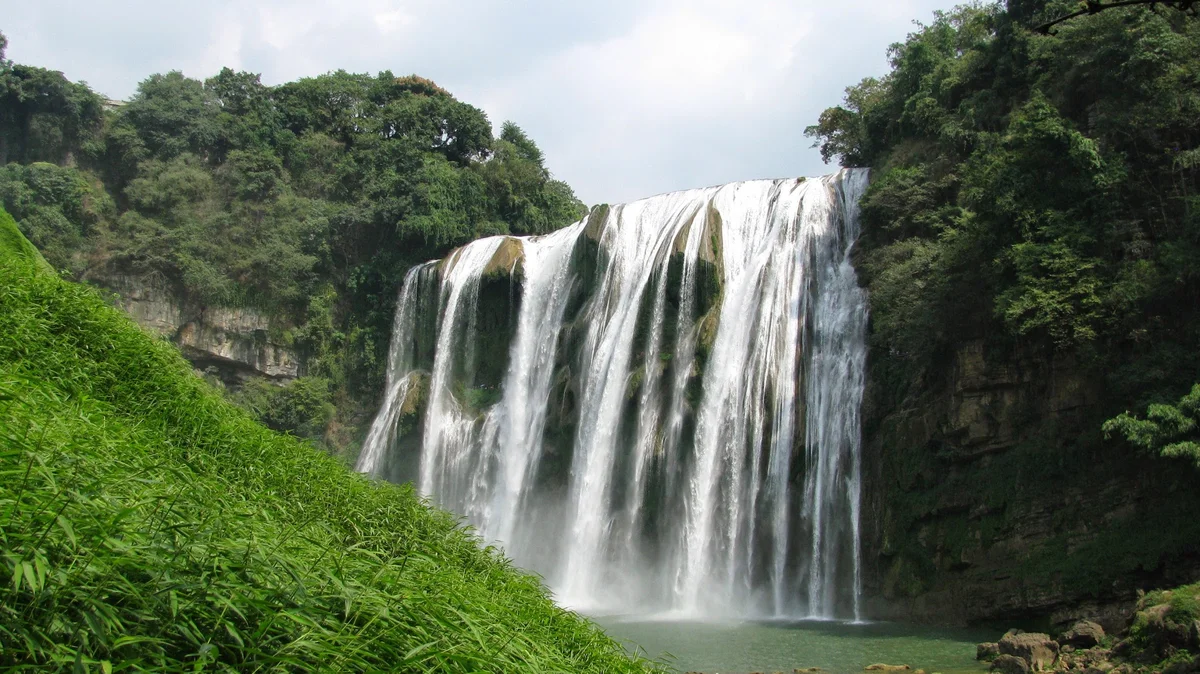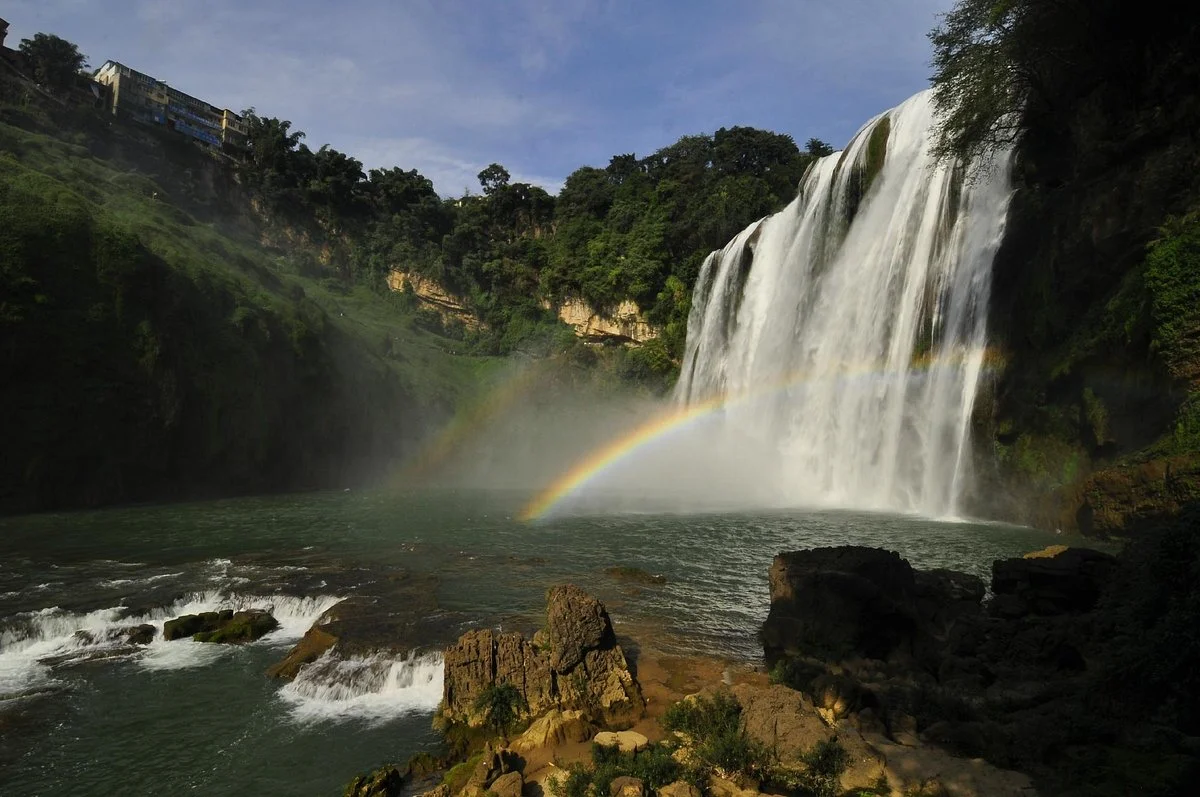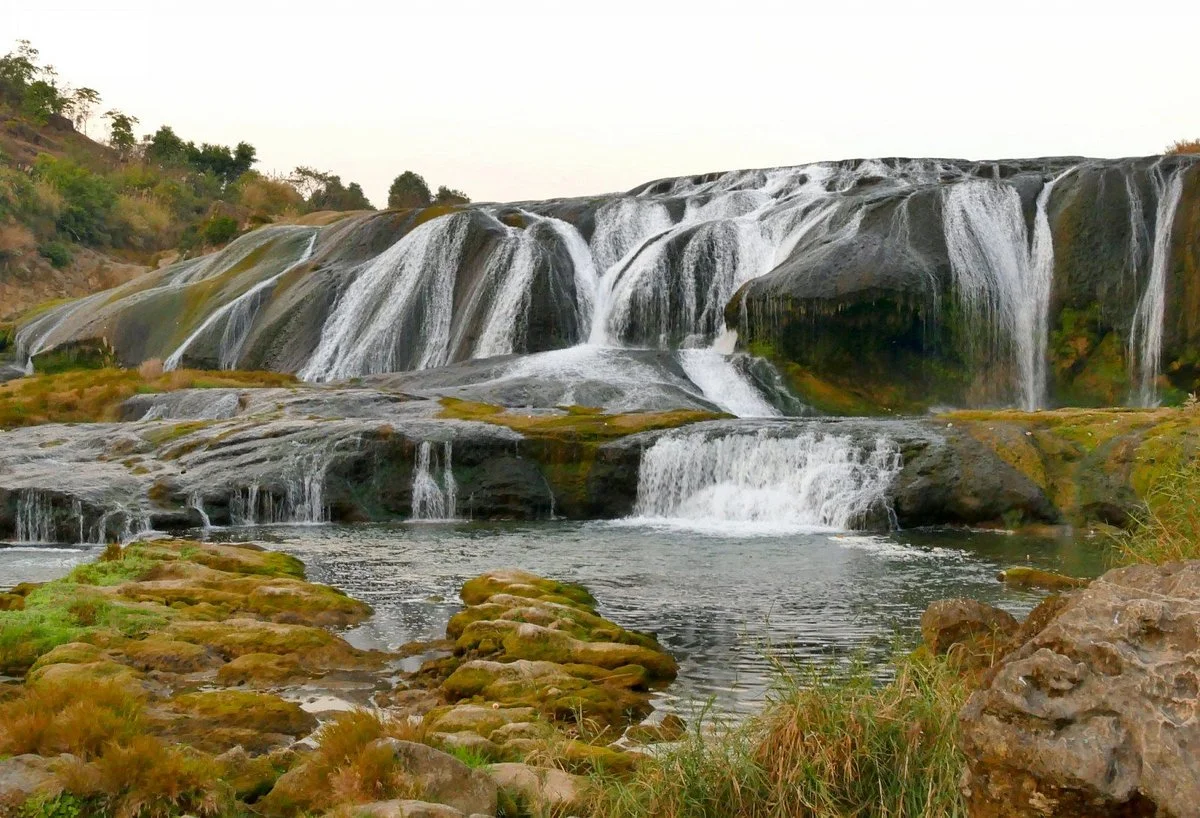
Anshun (simplified Chinese: 安顺; traditional Chinese: 安順; pinyin: Ānshùn) is a prefecture-level city located in southwestern Guizhou province, southwest China, near the Huangguoshu Waterfall, the tallest in China. As of the 2010 census, it had a population of 2,297,339. The city proper had a population of 765,313. Within the prefecture are attractions such as The Long Gong Dragon Caves and the Getu River.
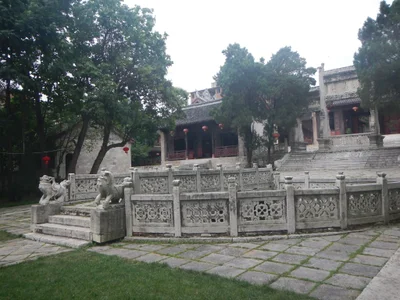
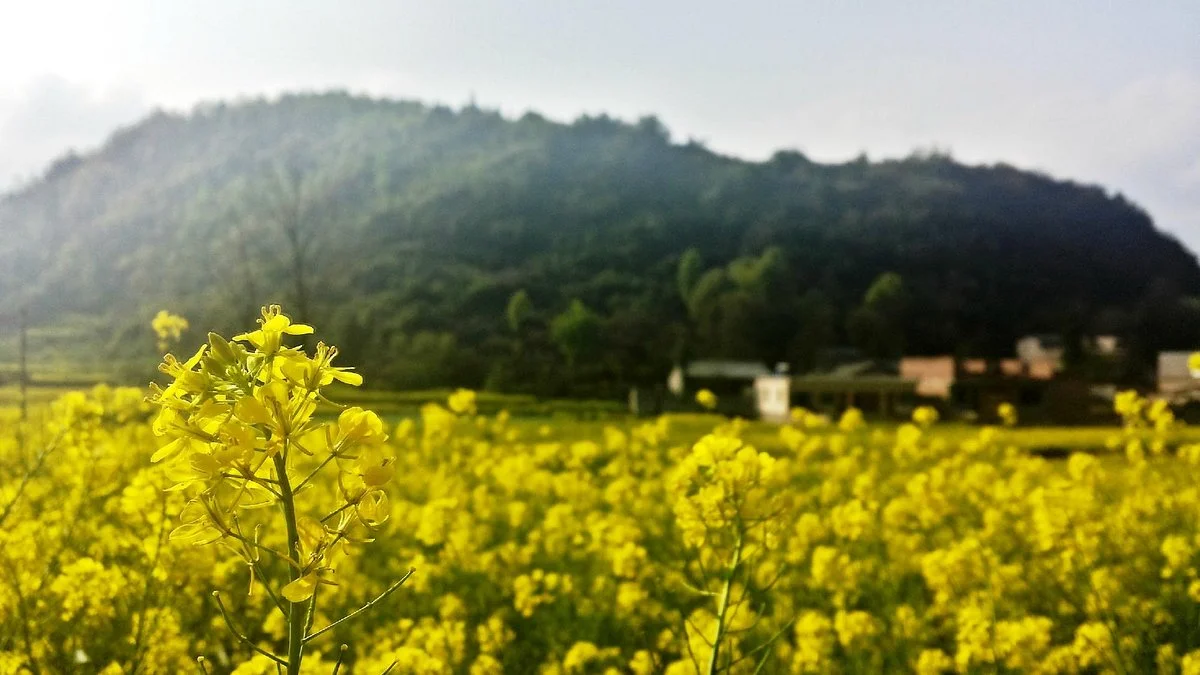
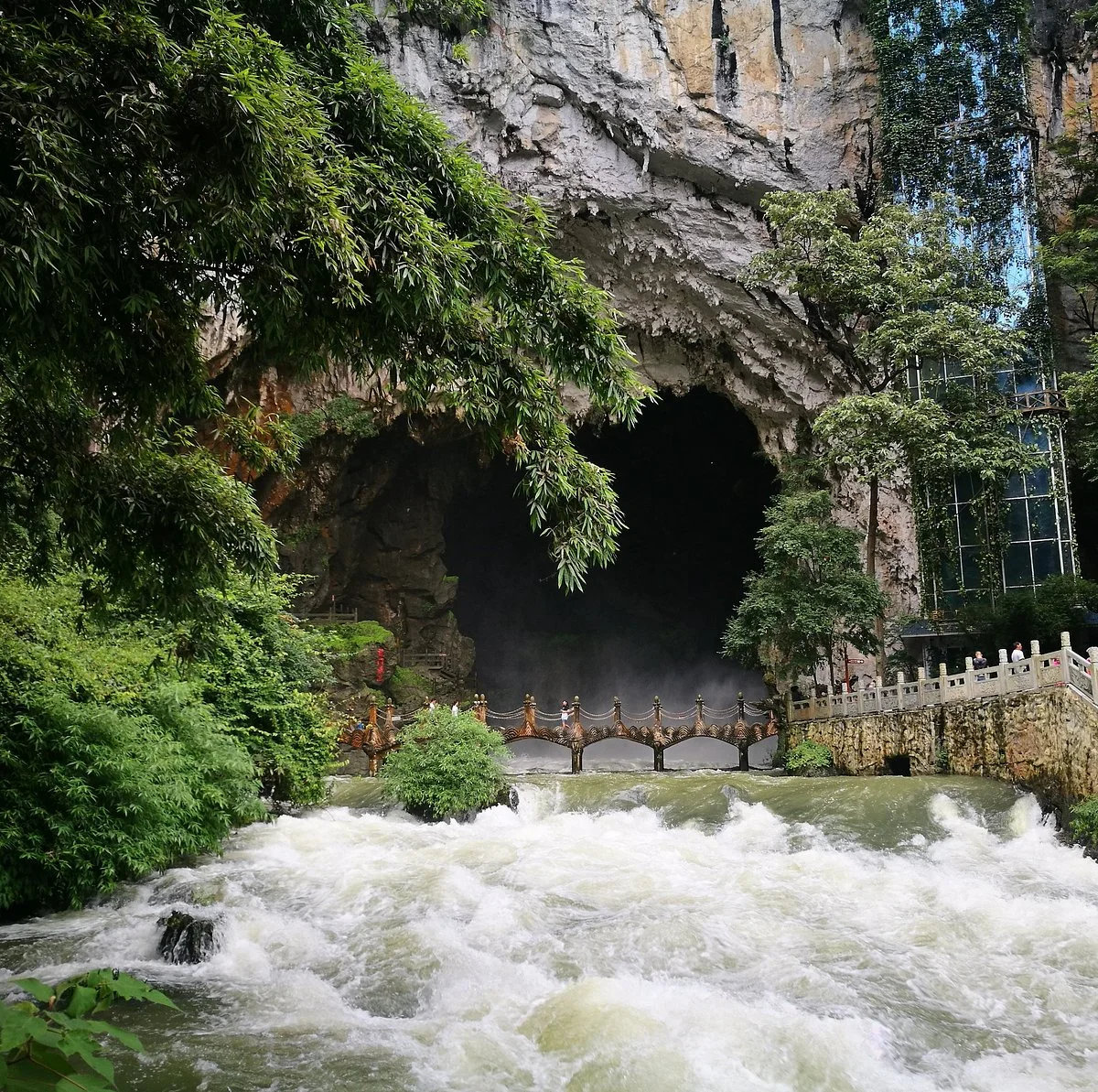
Despite the elaborateness of the Longgong park site, it represents only a small portion of the ninety or more caves in this network. However, like the Huangguoshu Falls area nearby, this region continues to be aggressively developed for tourism – and signs regularly appear pointing the way to modest new ‘scenic sights’ within the Longgong area. Only six caves, all connected by an underground river covering 854 m (2,800 ft), are open to exploration, accessed by boat through the flooded entrance, Tian Chi (Heaven’s Pool), which is partially concealed by a 40-m (130-ft) high waterfall. Inside, the largest cavern is about 80-m (260-ft) high. The caves are filled with colorfully-lit stalactites and stalagmites, and numerous oddly-shaped rock formations. During the rainy season, the boat ride ends at Tiger Lair, a broad platform from where visitors hike out of the caves and walk back to the entrance through an attractive stone forest of weathered karst spikes. The cave is visited by taking a boat tour through the cave but on the far side you have the option to get off and walk to the dry Tiger Cave. The mountain lake runs down to the river below in an impressive waterfall.; Most other sights here will be anticlimactic after the Dragon’s Cave and many people continue on to Huangguoshu Falls after finishing their boat tour. But if you want to linger, you can follow footpaths to some of the more modest caves or continue on to Guanyin Cave (观音洞), the second biggest attraction in the park, about 3km away.; To visit, you have to take a guided (Chinese-only) tour on one of the small boats, which lasts about 40 minutes (though in summer the flood of Chinese tour groups causes a watery gridlock that can draw this out substantially). There are three jetties inside the caves, and you need to change boats inside the caves in order to complete the whole journey. Life jackets are provided but choose carefully as some can be a bit dirty and smelly.; The guides give a little geological background on the caves, but mostly they just point out the various karst formations with their flashlights and let everyone play ‘What does it look like?’. The recorded music and coloured spotlights here can feel a bit over the top at times, but most travellers enjoy drifting through the caves anyway. When busy it can feel very rushed with little time to appreciate the beauty of the caves. It is like a tourist production line. The boat guide uses a green laser to point to interesting features within the cave for half a second and spits out its name but you couldn't see anything because it is all too fast.; Walking into another cave is quite challenging for older visitors as it is dark and wet in some places, and it is necessary to walk 6 floors down and 6 floors up steps along narrow limestone walls, but mostly the steps are low riser-types and there are sturdy handrails. Taking a lift to avoid climbing a staircase 10 stories high costs ¥25 one way. There is also a flying fox option for younger more adventurous visitors.; At the end of the walk, there is the choice of taking a tourist bus for ¥20 or walking another 7 km to get back to the starting point or entry. Entrance fee for seniors is only ¥5. Hiring a tourist guide for a group is ¥150; There are a few small restaurants serving farmers’ or villagers’ meals but at distinctly tourist prices. Not far away from the exit of the caves, there is a piece of grassland with a large Chinese character "dragon" and there you can take beautiful photo shots. — Address: Longtan Village, Longgong Town, Xixiu District — Price: ¥120 — Phone: +86 853 322 3173 An hour or two would be more than enough to see it all, and a stop here is a pleasant diversion either on your way to or back from Huangguoshu Falls. However, the karststudded landscape surrounding Shitouzhai is lovely and some travellers may consider hanging around to explore some of the villages spotting the nearby hills or to do some of the lovely walks that would be possible in the area.; Sleeping & eating; There is only one guesthouse open year-round ; Shítouzhai Jingqu Zhaodaisuo (石头寨景区招 待所; Tel: 1376-536 4841) Just a few metres inside the village gates and run by a lovely family, this place has simple beds in dark wood rooms. The wooden floors are disturbingly creaky but the shared bathrooms and showers are clean and modern. A single room with a Ming-style ‘antique’ bed costs ¥150. Others are under construction and should be accepting guests by the time you read this.; There are a couple of small restaurants here too, but they are only open in high season months (roughly April to September).; Getting there & away; To get here, take a Huangguoshu-bound bus from Anshun and tell the driver you are going to Shitouzhai (¥5-8, 30 to 40 minutes). You will be let off at a road forking away from the main highway. Follow the road for about 2 km until you reach Shitouzhai. You’ll know when you have arrived by the landscaping: there will be a pond with a waterwheel on the right, and, just afterwards, a clutch of stone houses on your left where you will find the village entrance. To leave, walk back to the fork in the road. If you are continuing on to Huangguoshu, most buses heading west will pass the falls; if you are going to Anshun, flag down any bus heading eastward. — Price: ¥15 Here once lived in exile the richest man in the world called Mr Shum. His wealth caused the Emperor to wish to kill him. Mr Shum gave all his wealth to the Emperor in exchange for an exile here. Tourists can see the house of his son where Mr Shum lived for a few years.; The village is easily reachable, about 25 km or half an hour from Anshun. The village is popular for its ginger infused tea served by local women is indeed refreshing. There is a Ground Opera performance at 11:00 that is worth watching if you get there at the right time. Bathrooms are at the entrance, so go before you go.; Visitors can hire a minibus in the Anshun minibus area near the railway station for ¥200 for a trip that takes about 30 minutes. You can then hire a guide at the entrance for ¥80 for 2 hours, which might be a good idea as the route winds through the village. — Address: Qiyanqiao Town, Xixiu District, Anshun 561006, China — Price: ¥30 These eight villages are close to each other, and mostly are preserved very well. Most houses are made of stones, even with stone slabs to make roofs for the house. As expected, villagers are the descendants of the soldiers from 600 years ago. They still keep on their traditional costumes, hairstyle, language. With so many army descendants everywhere, it is surprising that there are any minorities left.; From Yunshan it is a 15-minute walk along the road to the village of Benzhai (本寨), also at the foot of Yunjiu Shan. With its old pinched alleyways, high walls, carved wood lintels, stone lions and ancient courtyard residences, Benzhai is brim-full of history and is also stone and slate and undergoing restoration. There are a lot of old women in local dress who are very happy to be photographed. It is great whether you are a photographer or not. The village has lovely stone houses with slate roofs. The slate is laid out to form a diamond pattern, which is visually interesting and good for photos. ; Do not miss the chance to walk up to Yunjiu Temple (云鹫寺) at the top of Yunjiu Shan for some of the most extraordinary views in Guizhou. You can walk virtually all around the top of the temple for a sublime and unparalleled panorama of fields and peaks ranging off into the distance. In spring, flowering bright yellow rapeseed plants (youcaihua) add vibrant splashes of colour.; To reach Yunfeng Bazhai, take a bus (¥5, 40 minutes, every 25 minutes, 07:00-18:00) from Anshun’s east bus station. The last bus from Yunfeng Bazhai to Anshun leaves at 18:20, passing through Benzhai. Coming from Tianlong, hop on a bus from the main road to Qiyanqiao (七眼桥; ¥5, 20 minutes) and then take a motorbike (¥10) for the 10-minute journey to the museum and the villages. — Address: South of Xixiu District, Xixiu District, Anshun 561000 — Hours: 08:00-18:00 — Price: ¥70
The old part of Anshun, which lies in the northern of the centre area, is a nice place for an evening walk.
There are lots of places to eat in Anshun, but precious little to recommend. There is a food market down an alley off Zhonghua Nanlu, just south of the Bank of China. There are some bakeries and several hole-in-the wall places on Gufu Jie. There is also a huge supermarket on Zhonghua Nanlu, perfect for picking up snacks for day trips. Be forewarned: dog is eaten in these parts… lots of dog. You will often see the skinned animals boiled and propped up outside restaurants as an enticement to customers.
The region produces a lot of batik (蜡染画; làrǎn huà), some of the batik you see in Dali and most of it in Yangshuo is from Guizhou. There are also various other handicrafts. There are a group of stores selling these and other tourist bric-a-brac along the west side of the main street just north of the bus station. The train station is at the south end of the same street.
The stretch of Zhonghua Nanlu near Zhonghua Donglu is where the city's big commercial stores and shopping centres are located. The Wholesale Market of Small Goods in Anshun (Anshun Laran Shichang; Zhonghua Nanlu; 中华 南路) is the city's main market and probably the most interesting place to prowl. For a peek at the more contemporary side of Anshun, Gufu Jie is a street of trendy clothing stores and bakeries, and snack stalls that get so packed on weekends it is hard to move. Several ethnic groups across southwestern China have been traditionally involved in creating batik. For almost 1,000 years, the Bouyi around Anshun have been using batik as a background to embroidery on clothing, and since the establishment of a factory in Anshun in the 1950s, have come to monopolize the indigenous textile market. The designs, which were originally of abstract plants and animals, are drawn with wax on cloth. The cloth is then dyed in indigo before being boiled to remove all traces of the wax, leaving the pattern in white on a blue background. The earlier monochromatic batiks have now given way to multi-colored, mass-produced designs, which include stylized representations of zodiac animals, scenes from Bouyi legends, and mythical creatures. Today, Anshun's batik is in great demand across China.
There are twin rooms for ¥100 just on the left when you leave the train station.
There is a lot of midrange accommodation in Anshun that is geared to Chinese tour groups, which is generally drab and undistinguished. Anju Binguan (220 1359) has budget rooms right next to the station but the bathrooms are tiny. Directly opposite is the Xixhiushan Binguan (221 1888) has doubles for ¥200-300 but the rooms are ridiculously cramped. Bathrooms are exactly the opposite – sparsely outfitted and often the same size or bigger than the actual sleeping area. Gongdianju Zhaodaisuo on (332 9124) Zhonghua Nanlu; 中华南路; only has basic little budget rooms with Chinese toilets and cubby-hole-like showers with no doors. Henghuangshan Dajiudian (Golden Phoenix Mountain Hotel (322 5663) with is garish classical Greek façade on Tashan Donglu; 塔山东路58号) has similarly priced rooms that definitely starting to show their age.
Among foreign tourists, the two most popular choices are the two western branded properties. 219 Xihang Road.
Frequent buses travel between Guiyang and Anshun. The trip takes about 2 hours. There is still almost one hour's trip from Anshun to the famous waterfall, Huangguoshu.
Buses to Anshun leave from every one of Guiyang's stations (¥25, two hours, every 20 minutes from 07:00 to 19:00). Any Guiyang bound bus out of Xingyi or Weining will also let you off in Anshun if you tell the driver.
There are several bus stations in Anshun that are useful to travellers. The north bus station (客车北站; keche beizhan) has buses (¥34, three hours, every 20 minutes, 07:00 to 18:00) to Zhijin town (for Zhijin Cave). Almost every other bus now leaves from the new east bus station (东客运站; dong keyunzhan), 10 km east of the centre. Bus 16 (¥1) runs here from Zhonghua Nanlu opposite the Xixiushan Binguan. A taxi is ¥25 to ¥30.
Bus Number 1 zips around town from the train station and up Tashan Donglu, and on past the Hongshan Binguan. Bus 2 travels between the train station and the north bus station. Bus 16 runs from Zhonghua Nanlu to the east bus station. Buses cost ¥1. Taxi flagfall is ¥6.
Anshun is a popular tourist destination just south of Guiyang. Waterfalls, caves and cool temperatures make Anshun an ideal summer vacation spot. The average temperature of Anshun is about 21 °C in summer. The best season to visit it is from June to October. Anshun ranked No 2 in a list of the Top Attractions of summer 2018, released by China Tourism Academy in July, following only Kunming of Southwest China's Yunnan province.
Today's city survives on tourism, subsistence farming, and its traditional batik industry, which capitalizes on the highly developed textile skills of the local Bouyi minority. The road between Anshun and Huangguoshu is roughly where Bouyi country starts to get interesting, so you could take a break between the must-see destinations to walk the countryside and do a little exploring. The Bouyi number around 3 million and live throughout western Guizhou. A writing system for the Bouyi language was devised in the 1950s and is used to record their rich folk literature. Surrounded by karst hills, Anshun has one of Guizhou's most scenic landscapes in the province.
Central Guizhou is the most travelled region of the province and it is also where the province's star sights, such as Huangguoshu Falls, Longgong Caves and Zhijin Cave, as well as its capital city, Guiyang, are located. Tourists flock here to Huangguoshu, the tallest waterfall in China. While not very well known to westerners, the Chinese TV version of the “Journey to the West” being filmed here means that almost everybody in China knows this scenery. Located on the Baishui River in Anshun, it is 77.8 meters high and 101 meters wide. Tourists can view the falls from many different angles, at the six main observation decks. Other popular sites, include the kaleidoscopic Dragon Palace Cave, and the Getu Karst Park which hosted the 2014 Black Diamond International Rock Climbing Championships. The Great Arch has become a magnet for technical climbers. Measuring 70 metres high and seventy metres across it is one of the largest such formations in the world and a challenge to thrill seekers from around the world. The Dragon Palace Cave is a spectacular underground karst cave 32 km southwest of Anshun. You can take a boat into the cave to view its spectacular subterranean scenery.
This is not very far away from the fascinating Zhongdong or Middle Cave where until around 2008 around twenty families were living in a humongous limestone cavern 1,800 metres (5,900 ft) up a mountain. This used to be the world's only year-round settlement inside a naturally occurring cave in China. Fifteen kilometres away from the nearest town, it had its own classroom, and basketball court as well as village houses.