See Many of Qinhuangdao's attractions have been extensively restored or rebuilt in the 1980s. This includes most of the city wall as well as the Great Wall going towards the sea. The other side of the wall, going up the mountains, has been partly restored but some parts remain in their original, crumbling state.
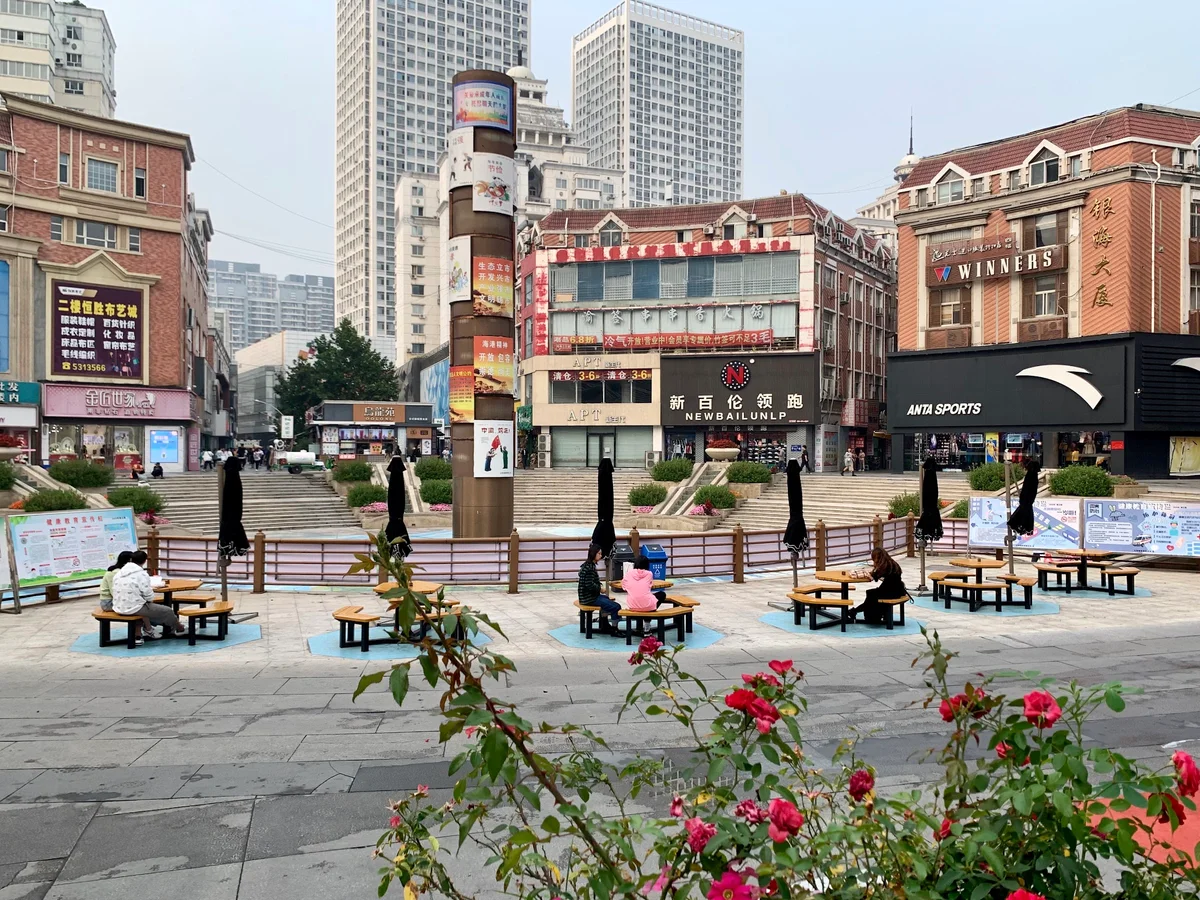
Much of the "old" town, especially along the main north-south road, was completely reconstructed in 2008/09. Several city blocks were remade into a faux-old Chinese city that, despite the lack of history, is quite pleasant to walk through. Most of it, however, is still largely uninhabited and quite like a ghost town. Especially in the evening after sunset, with the tourists gone, you will find even the main streets almost deserted.
• • Emerald Isle — Gold Coast is in the southern coastal areas. It is China's seven national marine nature reserves of the east, north, west, three from Bohai and seven around the Caspian (lagoon). It is known for it yellow sand, green vegetation and the peninsula. The island at rolling, beautiful shape, the highest point of 44 m, known as "the Jingdong desert " is called.
• • Gold Coast — Located in Hebei province Changli County southeast of Bohai coast, 52.1 km long coastline, with fine sand beach, soft, clear water, tidal flat, is bathing in the sea, sun, sand, forest bath, air bath place.
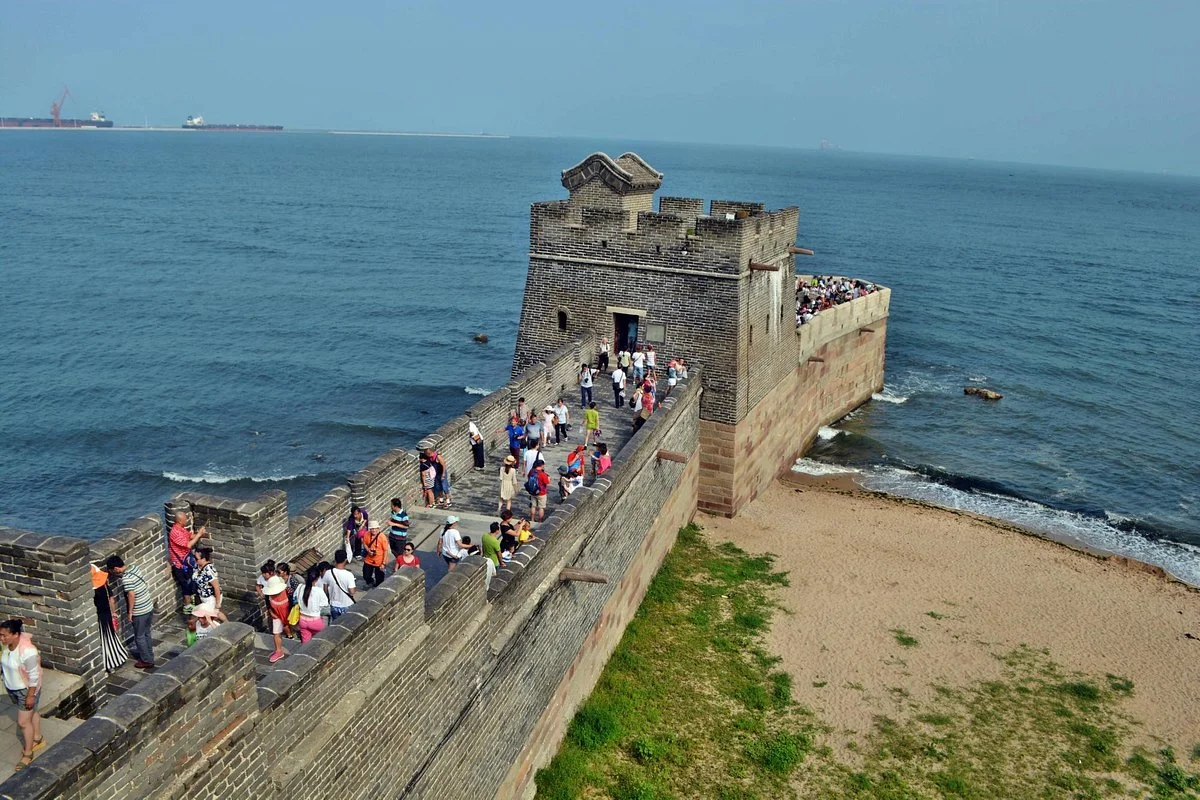
• • Old Dragon Head — At Qinhuangdao, the Great Wall juts out into the sea. The original wall is long gone, but an extensive rebuilt section has been put up. Bus 25 will take you there for ¥1-3. To get onto the wall and into an area with several rebuilt halls, you need to buy a ticket for ¥60. — Directions: Take bus 25 from the south gate or train station, taxi around Y10
• If you're content with seeing the wall hit the sea from the other side, turn left outside the entrance and follow the road making a right turn, going through the wall and to the beach. Walk about 200 m along the beach to get to the end of the wall. A fence has been put up preventing you to get closer than about 50 m to the wall, however, it may be possible to go through a hole in or under the fence. Judging by its appearance, several such holes have been patched in the past, but in Sep 2010, there is still one there. Passing the fence will not lead you to the paid area as the wall blocks you off from that.
• At low tide it is allegedly possible to walk around the end of the wall and enter the paid area without a ticket. If you want to do this, make sure you understand the risk - if you get caught, you can be fined several times the admission fee.
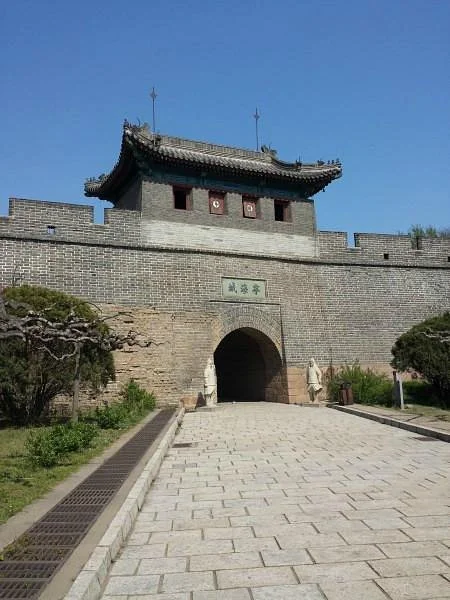
• • First Pass under Heaven — The area between the sea and the mountains at Qinhuangdao is called the "First Pass under Heaven", being the place where the Ming dynasty Great Wall began. Guarding the pass is the city of Qinhuangdao, with its (restored) east gate marking the main road through the pass. You can see the tower guarding the gate and, depending on choice of ticket, various exhibitions or take a walk along the city walls. — Directions: East of the Drum Tower in the center of the old town — Price: From ¥60 depending on choice of attractions
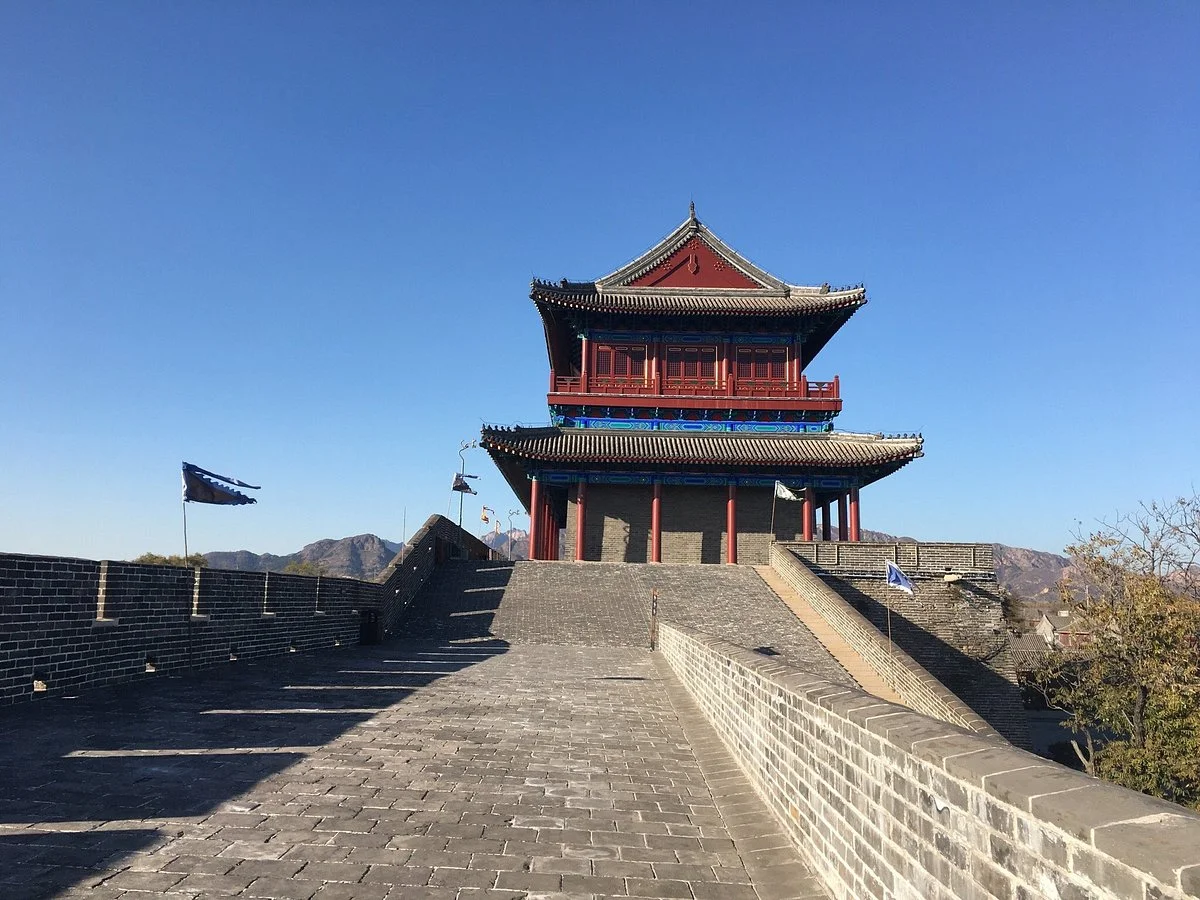
• • Shanhaiguan Fortifications — The walls of the old city of Qinhuangdao can essentially be considered part of the Great Wall: the whole city was built as a wall fortification to guard the pass between the mountains and the sea. The walls of Qinhuangdao are square, with a perimeter of around 4 km in length. The walls reach the heigh of 14 m, and are 7 meters thick. The east, south and north sides of the fortification are surrounded by a moat 3 m deep and 5 m wide. There are drawbridges to get over the moat. You can only go up on the wall by buying a ticket for the First Pass under Heaven (see above). The other sides of the city have gates as well, but these have been rebuilt: the original buildings long gone.
• • Five Buddha Park, Jiao Shan — Further inland, there's a fairly extensive park near another section of the wall. Here, the wall can be seen snaking it's way over the hills. The lower part has been restored in the 1980s, you can walk up the hill about 2/3 of the way before an unrestored part of the wall has been blocked off by a concrete barrier. Next to the wall, there is a walkway towards a temple further back in the hills (alternatively, you can take a chairlift from the bottom). From the temple, you can reach the rear part of the wall going over the hills, where it is made of raw stone rather than bricks and in many places not much more than a convenient walking path remains. By walking south from here, you can reach the other end of the unrestored brick-wall section, blocked by an iron fence on this side. For the adventurous, the barriers on either side are not insurmountable, but some steep parts and loose stones makes this section less safe than those below and above it. — Directions: Head straight north from the north gate, 2-3km, taxi Y10 — Price: ¥30 — Website: http://www.greatwall-china.com/shan-hai-guan/landmark.html
• • Laodao Ocean Park — Laodao Ocean Park, with the theme of Ocean Park, is 8 km from Qinhuangdao Airport and 2 km to Old Dragon's Head Great Wall. The park offers rich and colorful entertainment items, which all bring happiness in your tour. The park breeds numerous sea animals and the sea lion, dolphin, and beluga will play brilliant performance. At the bottom of the sea, you can get zero-distance contract with wild animal of ocean, and explore the arcanum of nature as much as you like. Meanwhile, if you are interested in the natural culture, you will have a chance to view the performance full of exoticism. The polar region exhibition hall takes you to the romantic world of ice and snow, and hope you will have a good time with the cute polar bear and penguin. At night, the ebullient bonfire party will give you a enthuse evening absolutely.
• • Other Great Wall ruins — When heading out to Jiao Shan (above), you will see a large earth wall on the right side about 50 m from the road. This is actually a (completely unrestored) part of the Great Wall. On the barbarian side (east) you can still see the bricks and the moat, while the top and the western side are overgrown and few bricks remain. Locals can be seen herding sheep or walking their dogs on this part of the wall. From the road, you can see small paths leading up this wall at intervals; to get to Jiao Shan, the walk up here is much more pleasant than going along the road. When you reach Jiao Shan, the wall is blocked off by a barbed-wire fence, so you will need to buy a ticket to get in. Alternatively, you can walk off the earth wall on the east side and follow a path leading up the hills to a small watchtower. There is another path from here leading off into the hills, but it's not used much and heavily overgrown in places.
• • Great Wall Museum — Admission is included with some of the First Pass tickets, but it's not inside the compound. — Directions: take the southeastern gate (near the train station) to the old town and walk north along the eastern wall — Website: http://www.greatwall-china.com/shan-hai-guan/great-wall-museum.html
• • UCCA Dune Art Museum — Winner of the 2020 Leading Cultural Destinations (LCD) Berlin Awards in the New Culture Destination of the Year, Asia-Pacific category. — Address: Aranya Gold Coast Community, Changli County (昌黎县阿那亚黄金海岸) — Directions: it is advertised as being in Beidaihe, but it's a long way from Beidaihe District; he best way to get here would probably be to take a car or tax; if you insist on using public transport, take a long-distance bus to Changli (昌黎) (because trains only go to Changli in the evening), then walk 780 m north to the Wuliying (五里营) bus stop to catch a bus no. 10 to the Changli Railway Station; once there, you will need to transfer to bus no. 20; get off at Aranya (阿那亚). From there, it's a 1.5-km walk to the gate of Aranya Gold Coast Community and then a 2-km walk from the gate to the museum — Hours: Nov-Apr: Tu-Su 10:00-17:00; May-Oct: Tu-Su 10:00-19:00. No entry in last 30 minutes. Closed on Mondays and during the Spring Festival — Price: Tickets are normally ¥80 each. Discounts are available for students, children under 1.2 m, disabled people and persons over 60 — Phone: +86 335 7522652 — Email: ve@ucca.org.cn — Website: https://ucca.org.cn/en/
Read more