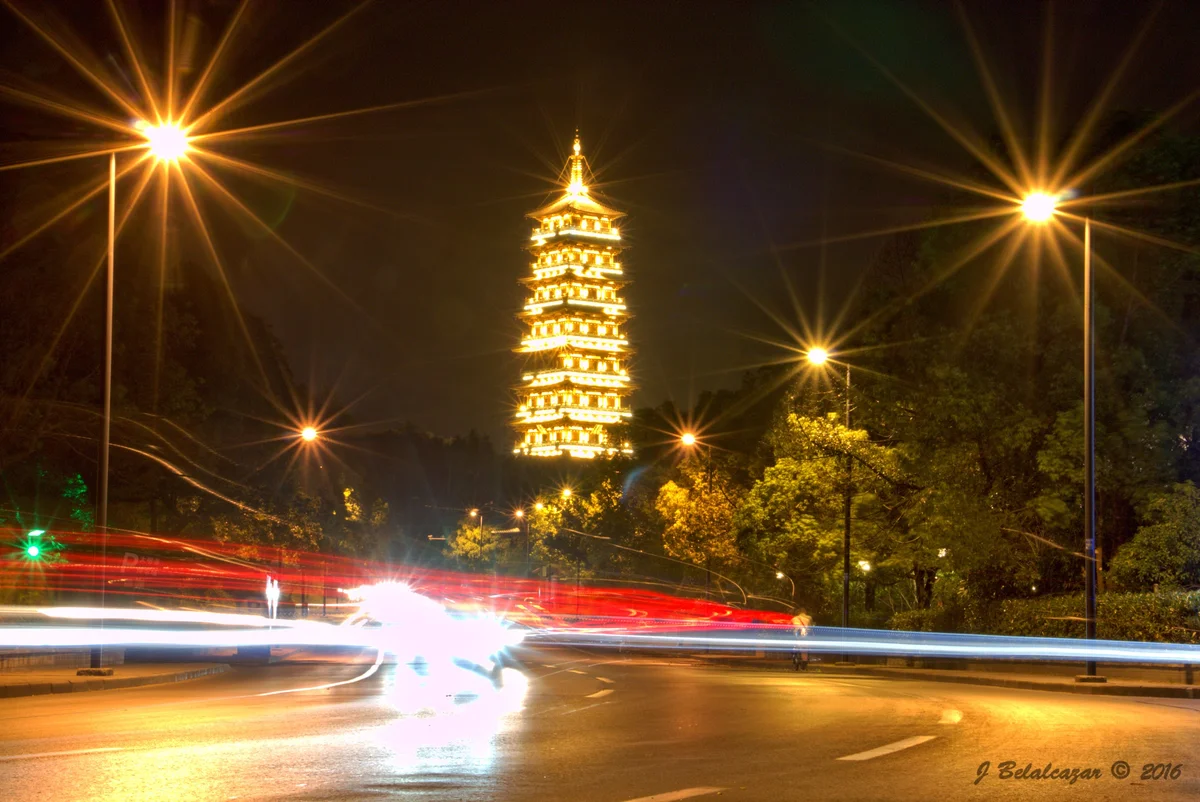
Yangzhou is a prefecture-level city in central Jiangsu Province, East China. Sitting on the north bank of the Yangtze, it borders the provincial capital Nanjing to the southwest, Huai'an to the north, Yancheng to the northeast, Taizhou to the east, and Zhenjiang across the river to the south. Its population was 4,559,797 at the 2020 census and its urban area is home to 2,635,435 inhabitants, including three urban districts, currently in the agglomeration.
Historically, Yangzhou was one of the wealthiest cities in China, known at various periods for its great merchant families, poets, artists, and scholars. Its name (lit. "Rising Prefecture") refers to its former position as the capital of the ancient Yangzhou prefecture in imperial China. Yangzhou was one of the first cities to benefit from one of the earliest World Bank loans in China, used to construct Yangzhou thermal power station in 1994.
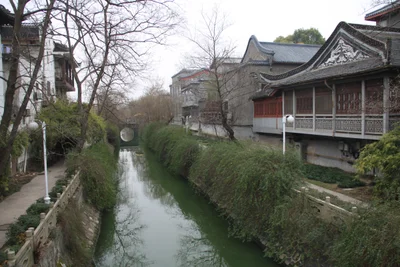
Stroll along the Xiaoqinhuaihe Canal (小秦淮河) that crosses the city's historical center, and the narrow lanes of the (few) surviving blocks of the old city nearby.
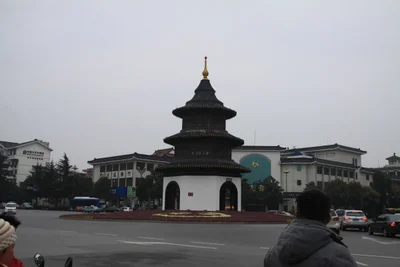
Go for some exercise in Songjiacheng Sports and Recreation Park (entry free; some sports facilities may require fees. Open 17:30-21:30). It's on an island east of the Slender West Lake Scenic Area. The park has an interesting past: farmers' fields and a few small villages were converted to a Wetlands Nature Park in 2005, then to Songjiacheng Archaeological Park around 2009, and finally to a sports park in 2015. Boardwalks through the marshes surrounding the island have been inherited from its Wetlands Park incarnation, while the four gate towers, from the Archaeological Park period. The rest of the landscaping apparently comes from the 2015 remodeling. One can enter the park from the Changchun Rd (via its southern or western gates), or from Shouxihu Rd (via the eastern gate). Bicycles are not allowed in the park, except for those rented in the park itself (at the rental station outside of the western gate); those can be used on the 3,200 m long bicycle trail around the park's perimeter.
On a summer day, walk on a boardwalk trail to Baozhang Lake (保障湖) a popular locals' swimming place, about 2 km north of downtown. The trail starts outside of the southern gate of Songjiacheng, and runs east and north outside of the park's borders (within a narrow strip of greenery that's separated from the Songjiacheng park by the lakes' water).
The big-name local dish is Yangzhou fried rice 扬州炒饭, filled with fried egg, muer mushroom 木耳, ham, shrimp, scallions, peas, and carrots. It's representative of the Huaiyang cuisine. Other famous dishes include the Lion's Head 狮子头, which is a giant meatball made with pork and crab. Also suggested is; semisweet Thousand-layer cake 千层糕, steamed dumpling 蒸饺, amazing tofu noodles often like chicken soup 大煮干丝, delicious soup fill dumplings 小笼汤包, and stinky tofu 臭豆腐. For breakfast you'll be sure to find steamed filled buns (baozi)包子, steamed buns (mantou)馒头, rice porridge (zhou)粥, boiled eggs (zhujidan)煮鸡蛋.
If these choices look unappealing to you—or if they look appealing, but you just don't eat that stuff—try Damingsi Vegetarian Restaurant 大明寺素菜馆, 1802 Wenhui Road East. It's affiliated with the temple, and serves vegetable-matter simulacra of the local favorites for very reasonable prices.
The most popular beer is from Shenyang, called Snow 雪花啤酒, and costs around ¥3 for a large bottle. But should you want something with a stronger beer-flavor, the L-Mart at the Living Mall has Kirin Japanese beer, brewed in Taiwan, ¥5 a can. The Living Mall 京华城 also boasts a Starbucks 辛巴克, semi-conveniently placed between the train station and the RT-Mart.
For goods and necessities, there are 2 RT-Mart(s) (大润发 da run fa) one on Hanjiang Road and the other on Wenchang Middle Road; several bus lines run there from downtown and from the local colleges. As far as Western products go, RT-Mart, Tesco (Hanjiang Rd, north of the old bus station) or Auchan (Jiangyang Rd, east of the old bus station), are good.
One major local industry is ceramics and teaware; a few big ceramics factories and showcases can be visited here.
Not a shopping mecca, however, there are a number of department stores in the city centre. Here you can find the Golden Eagle Shopping Centre (in the city's main square, facing the Wenchang Pavilion), Times Extra Mall and the Times Square Mall. If you feel the need for a more Western-style shopping experience, the Living Mall, in the new development zone, was completed in 2008 and is easily reached by taxi. Big name foreign and domestic designer brands, western style restaurants, K-TV bars and a cinema can be found here.
Unlike most Chinese cities, Yangzhou has little lodging available in the train station area, although a Hanting Hotel has opened in the new bus station building (next to the train station).
Although some hotels are found in major streets all over the city, they are mostly concentrated in two areas: around downtown, and within a few blocks of the old main bus station (Jiangyang Rd and Hanjiang Rd, a few km to the southwest of downtown). The demolition of the old bus station has not affected the hotels too much, since Jiangyang Rd is still the natural route for entering the city by car. As of 2017, room rates start from around ¥100 in both areas.
As elsewhere in China, some smaller hotels are closed for a few days around the Chinese New Year, while others raise their price around this and other holidays, when crowds of tourists from all over the country descend on the Slender West Lake area.
City buses are reliable and cheap (¥1-2 fare usually), but many routes stop running around 18:00-19:00, the rest around 22:00. Bus stops are well marked; bus schedules (in Chinese), with the list of stops along the route, are posted at bus stops, and routes are shown on city maps that can be purchased e.g. at the Xinhua bookstore downtown. Routes that run in the evening (after 18:00-19:00) have the letter "w" appended to their route number; the evening route may be different from the daytime route (the list of stops posted at each stop will indicate that).
Many city bus routes originate at the West Bus Station (adjacent to the railway station). One can board the bus inside the bus station, before the bus becomes more crowded as a lot more people will board at the outdoor bus stop in the station square. The East Bus Station (of less use to most visitors) is also the terminal for many bus routes.
Taxis are widely available. Flat rate starts at ¥7, and all are metered (it is illegal to drive an unmetered taxi). If your feet get tired and you want an exhilarating ride, pedicabs are also abound in the city center, especially around tourist sites.
Bicycling around Yangzhou is fairly pleasant, as major streets usually have separate bicycle lanes, which, outside of the city center, are usually not crowded. As in other Chinese cities, public rental bicycles abound throughout the city (2018), but probably require a local resident card and a Chinese smartphone to use. Ask your local friends for help.
The city has a history of over 2,500 years and developed as a major trading center for salt, rice and silk. Marco Polo served as the city's governor (or possibly a Salt Official for the government, or he just stayed there for that period of time) for three years in the late 13th century. Yangzhou has a population exceeding 1,000,000.
Built on flat land a few miles north of the Yangtze River, Yangzhou is criss-crossed by a network of canals of all size, from the Grand Canal of China (which, actually, has two routes - the old, next to the city center, and the modern, a few miles to the east) to small neighborhood canals.
Several walled cities existed here over the two millennia, but even the last (Ming Dynasty) wall has been demolished long ago. Still, the contours of the Ming city wall are traced by the canals surrounding the two kilometer square in Yangzhou's city center. New neighborhoods have grown for about 5 km or more in all directions outside of the former walled city.
Yangzhou is the birthplace of former Chinese politician and general secretary Jiang Zemin, the 5th president of China.