Get around The old city is surrounded by a rectangular city wall. The Bell Tower (钟楼 Zhōnglóu) is in the dead center of the rectangle, and is considered the center of Xi'an. From here, the four main streets radiate along the four points of the compass.
• North Street (北大街 Běidàjiē)
• East Street (东大街 Dōngdàjiē)
• South Street (南大街 Nándàjiē)
• West Street (西大街 Xīdàjiē)
Do not get confused by different names in tourist guides, addresses and bus stops: Nandajie, Nanda Street, South Street, and South Avenue are all the same street.
Locals often speak about Within the city walls (城里 chénglǐ, CHUNG-lee) and Outside the city walls (城外 chéngwài, CHUNG-why) when talking about locations. Outside the walls, the southern part is the most interesting - it offers shopping streets, bars and some nightlife.
Basically the inner Xi'an, the part inside the City Walls, is the old Xi'an, which is equivalent to the term "downtown" used to describe certain parts of a North American city. The buildings are mostly pretty short due to government policies. People who live inside the City Walls largely preserve a traditional way of life. For example, they are used to going to farmers' market for grocery, and also the provincial dialect is more prominent there. There is much more folklore to be found inside the City Walls than elsewhere in the city. Interestingly, there is a Roman Catholic church in the inner city, which was founded more than 300 years ago by the missionaries from the west.
There has been several urbanization projects happening since the 2000s in the southern part of Xi'an, outside of the City Walls, notably Xi'an Hi-tech Industrial Development Zone. That's where you can find the new, and urban aspects of Xi'an. Large-scale shopping malls around that area are very popular among the new generations. Each shopping mall usually is a combination of restaurants, shopping areas, groceries, and entertainments. Also a considerable population from other parts of the city have relocated to this area for their children's education, since there are few prestigious schools in the area.
As usual in China, subways are the easiest way to get around if they serve your destination. There are also plenty of buses traveling everywhere at short intervals (main lines run every 5–10 minutes). If you are not confident enough with orientation, or if you do not like packed buses, the cheap taxis (出租车 chūzūchē, literally translated as "rented car", which is pronounced as CHOO-TSOO-CHUH) are the best alternative, broadly available, except for during rush hours.
Read more Eat The Xi'an as is today is very different from like 10 or 20 years ago, when there were only certain restaurants known by the locals to serve delicious food. Now the restaurants are everywhere, especially ones like KFC and McDonald. Unfortunately the younger generations don't seem to appreciate the traditional cuisines and rather choose to eat fast food. Therefore, some of good old restaurants are forced to close down, being taken over by the newer ones.
Xi'an specialties include:
• Yángròu Pàomó (羊肉泡馍) is one of the signature dishes of the area, it consists of a piece of thick, chewy bread and a kettle of lamb soup. The diner shreds the bread with his hands and places the shreds in a bowl, the soup is then poured over the shreds (along with meat, maybe some noodles or scallion, etc.) The trick is to shred the bread into pieces that are "as small as possible", like the size of your pinky fingernail. Most first-timers will shred their bread in pieces that are too large. In some restaurants, they have already shredded the bread for you. It is normally also served with pickled garlic and chili. If you don't like lamb, some restaurants also offer a beef version. The best, and the most authentically made of this dish can be found in the Hui Muslim Quarter.
• Biáng biáng miàn ( 面) is a local provincial specialty noodle dish that is extremely good. The wide noodles are spiced, have a broth, and include toppings such as eggs, tomatoes, beef, etc. The character for "biang" is very complex (58 strokes) and distinctive. Although this kind of noodles has created a brand of the same name (trademarked), under which several such restaurants are run across the whole city, not every one serves the noodles that taste like the original. It's advised to go to the one restaurant that has lasted for the longest time, which is located in Fen Alley, within the City Walls. It is know by the locals as the most "authentic" (正宗) Biáng biáng miàn.
• Ròu jiā mó (肉夹馍) is the closest thing to a hamburger. This is a local tradition and should be very easy to locate. Sandwich-like, with pork, beef or lamb, this is a must-try item for anyone who is in this area. Still, as a dish that is derived from Hui people's cuisine, the best Ròu jiā mó restaurant is to be found usually within the City Walls, specifically in the Hui Muslim Quarters. Not every Ròu jiā mó restaurant in the city serves the food just like the original. A recommendation of such an "authentic" restaurant would be Yú Lǎo Dà (literally translated as "Mr.Yu's") located in the Wuxing Street, just across the Roman Catholic church. It mostly serves food for breakfast, so get in there in the morning just in case it closes at noon.
• Xiǎo lóng bāozi (小笼包子) are basket-steamed dumplings (one basket ¥3), common as a midnight snack. Look for its big brother "Da baozi" only available first thing in the mornings, like a steamed Cornish pastie, but very nice.
• Guàn tāng bāozi (灌汤包子) are steamed buns served with sauces inside.
• Shìzi bǐng (柿子饼) are buns made from persimmons, stuffed with something (e.g. black sesame paste), and deep-fried, so they're quite sticky-sweet. You can find many sellers in the Muslim Quarter, and they are only ¥1 each or less!
• Lǜdòu gāo (绿豆糕) are literally green bean cakes (come in small cubes), but they're more moist than you may find elsewhere and also come with a variety of mixings (e.g. sesame). Half a Jin should be about six cubes and cost about ¥5 at a cart in the Muslim Quarter.
• Ice Peak, or BīngFēng (冰峰) is a kind of carbonated orange-flavoured beverage that is a provincial specialty. Its taste is very similar to the orange-flavoured Fanta, but locals still prefer the "traditional" Ice Peak. It is usually served in traditional restaurants, mostly within the City Walls, such as Biáng biáng miàn restaurants. It is known by the locals to be made with better-quality oranges, and therefore the company is not making as much profit as, for example, Coca-Cola. The price for one glass bottle is usually ¥2-3.
Some good places to look for restaurants are:
• The Muslim Quarter close to the Drum Tower is a vibrant area with many restaurants spilling out onto the street and mixing with the street sellers. If you're looking for snacks, this area is also full of people selling dried fruit (especially dates) and nuts/seeds (sunflower, melon, pumpkin, etc.) Prices are per Jin (500 g) and are pretty much standardized throughout the area, so you can't really bargain unless you're buying a lot (but who wants 1 kg of peanuts anyway?) Watch out for the pits in the dates! As its name suggests, this is a good place to look for halal food. Since the Muslim Quarter is basically a series of small alleys, there are multiple entrances. The one commonly used by the locals is located behind a shopping mall called Bǎi Shèng (百盛) on the West Avenue, at the northern end of the South Guangji Street. Another one where you can find meat shops more easily is located at the northern end of Qiaozikou. Visitors usually are directed to the one behind the Drum Tower, where you can find more souvenir shops.
• Street food (mostly sold after sunset, or some near night clubs/bars after 23:00) presents a variety of local/regional dishes, ranging from noodle soups, dumplings, hot pot, and so on by tens of little food vendors on street side, each with a red lamp. There are a few roads running perpendicular to the Muslim Quarter road that have a larger variety of streetside food (at cheaper prices because these roads are harder to access). As streetside stores are nearly a model of perfect competition, look out for food sold at significantly higher prices, yet maintain a long queue as these are likely to be tastier. For instance, some vendors may unscrupulously sell beef mixed with lamb and pass the meat off as pure lamb meat to cut their cost, however those who sell real lamb meat usually charge a higher price.
• If Muslim food isn't your thing, you can find a few more typically Chinese restaurants on Dongmutou Shi (东木头市) southeast of the bell tower.
Read more Do • Stroll round the Drum and Bell Tower area after dark, when they're brilliantly illuminated.
• • Hui Muslim Quarter — Walk through the Muslim quarter sampling food and buying souvenirs. The Hui Muslim Quarter (回民街 Huí mín jiē, hwei-min-jyeh) is a series of small alleys located in a high-density Hui community (very much like Chinatown in North America) inside the city walls, where the residences open up small restaurants and food shops. Street food is also very common as well. Some of these restaurants are among the most famous ones in the city, regarded as the "true Xi'an cuisine" by the locals. The food served is very special in flavour compared to other kinds of local food. However, visitors from outside the city may dislike the environment while the locals may not, because garbage can be seen almost everywhere on the street. — Directions: northwest of the Bell Tower
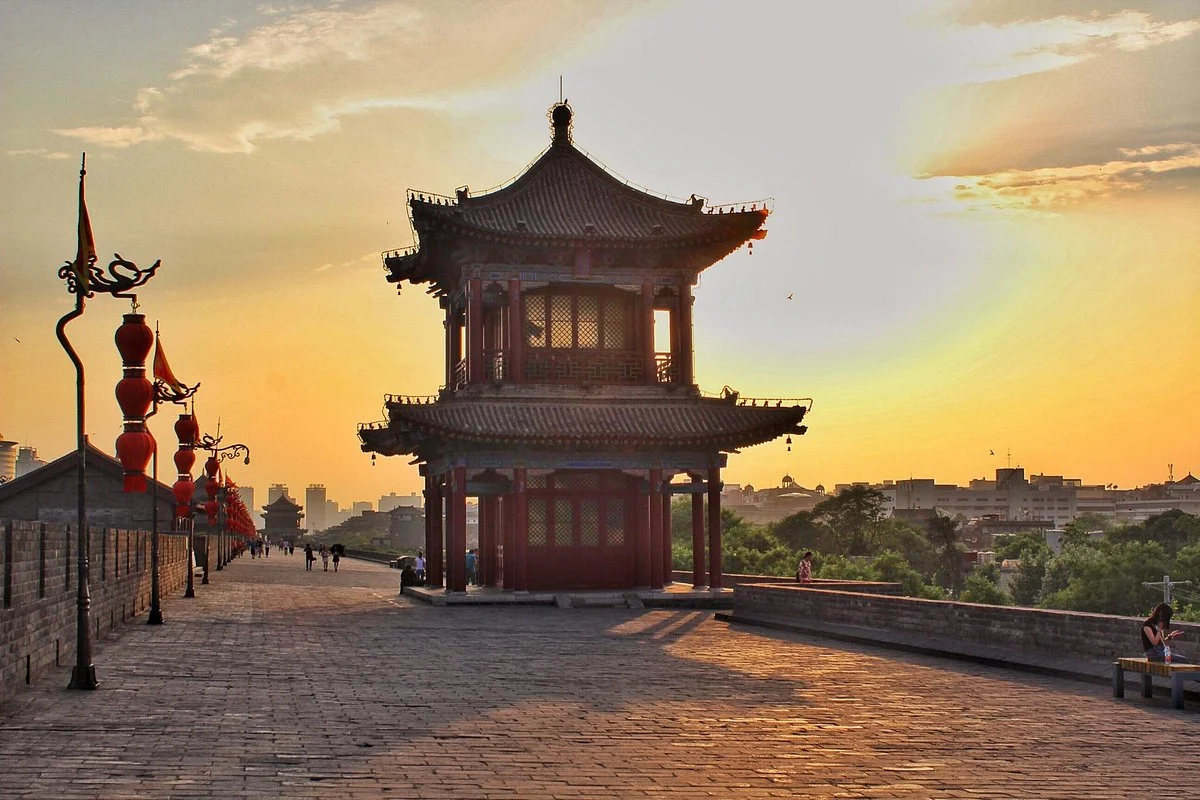
• • Walk the City Walls — Walk along the city walls and see the South Gate (南门 Nánmén, literally translated as "The Southern Gate"), which is illuminated at night. The area outside of the "Gate" is full of big shopping malls that are popular among the locals, marked with the iconic glass-curtain walled buildings. The area is one of the busiest places of interests in the city.
• • Bike the City Walls — Bicycling around the city walls will take about 2 hours leisurely and just over an hour if you only stop a little. Bicycles can be rented on each of the four main gates for 180 minutes, ¥45 per person (=¥90 for a tandem), and it may to be returned to any of the other stations (however, be sure to verify this before starting your ride or if they are still open as the other gates close at ~20:00). Remember to take your passport with you as a deposit for the bike that you rent, or ¥200. Make sure that you keep the deposit ticket, as the bike vendor will not give you the deposit back without it! Also, the bikes are generally relatively new and well maintained, but check the tire pressure and whether the brakes work before choosing yours. It's good to enjoy the scenery while biking the City Walls, but the biking experience may not be very pleasant. Because the City Wall's ground is very bumpy in nature (it was paved around 200 years ago), most people give up in midway because they can't bear the uncomfortable riding experience. Also choose a day when the weather is friendly, usually in Spring and Fall.
Read more Drink Night clubs in Xi'an are not abundant. All clubs play the same music, a mix of Chinese disco and some pop music. Most people go out between 22:00 and 01:00, but clubs are generally open until 04:00.
Be mentally prepared to be aggressively approached by club operators desperate for patrons.
In summer time, the area around South Gate (南门) is beautiful. East of it are three nice bars with terraces and gardens.
Along the short Nandajie (南大街) are the most clubs (you can also eat on the street as there are restaurants open past midnight).
• • MIX — Rather nice places to sit and drink. — Directions: Big light ad
• • Palando — Rather nice place to sit and drink.
• • Night Cat — Dance floor, some foreigners and OK DJs.
• • Kulala — Dance floor.
Other options include:
• • 1+1 — Remains one of the most popular clubs and definitely the most popular among foreigners. The club has 2 dance floors: first floor is mostly J-pop music, second floor is mostly hip-hop. There is a relaxed open air bar on the 5th floor which has live music every night. — Address: Dongdajie (东大街) — Directions: in the middle of the street
• • De Fu Lou Cafe & Bar — In Bar Street (De Fu Xiang), one of the first bars ever to open in Xi'an and a favorite hangout for locals. Live football on the big screen and live music every night. — Address: De Fu Xiang Street
• • Salsa — It is probably the most popular club. This club is your best bet on Fridays and Saturdays however yi-jia-yi is more consistent during the week. The dance floor, while smaller than yi-jia-yi's, is usually less crowded, so you have a bit more room to dance. Be careful if your group is mainly non-Chinese as they sometimes decide to limit the number of foreigners allowed in. — Address: 7F, Parkson building, No.107 West Street
• • Off-road Tea Bar — Has been checked by Google Business. Here, one could enjoy the fresh green tea in Southern Shaanxi and could meet local cycling and trekking lover. — Address: Jiefang Road — Directions: 800 m S direct to Xi'an Railway Station
• • Havana Bar — Has a Colombian band and makes good cocktails. It's not your average Buena Vista Social Club, though: they play loud music in between band performances and the band plays a wide array of pop and salsa. This location is more of a club than an actual Latin bar. — Address: Renmin Square — Directions: in Sofitel Hotel
• • The Belgian Bar — The first and only Belgian bar in Xi'an. Friendly pub atmosphere and huge range of beers. Popular with expats and locals. Awesome location facing onto the city wall. — Address: 69 Shun Cheng Nan Lu Dong Duan — Directions: 150 m east inside the South Gate — Phone: +86 13201672369 — Website: http://belgian-bar-xian.com/
• • Vice Versa — Vice Versa is a cultural mix of east and west, found in one of the older districts of Xi'an. With a relaxed cafe/restaurant open during the day, a lively bar serving a mix of western and Asian beers/cocktails at night, and a crowd of expats and Xi'an locals. Has a skate shop on the third floor, run by Converse pro-skater Xiao Jian. It is next to the front gate of the Forest of Steles History Museum, next to the city wall at Wen Chang Gate; you can call Mike at 151 092 72480 if you get lost. — Address: Wen Chang Men (Wen Chang Gate) — Directions: Beilin History Museum (Beilin Bo wu guan) — Hours: 15:00-05:00 — Phone: +86 151 092 72480 — Website: http://www.viceversa.cn
• • Park Qin — An underground basement bar (underneath Xi'an Shuyuan International Youth [Party] Hostel [see listing below]). Always packed, with live entertainment and a lot of laowai. Go early to get a table. Entrance not marked. Press blue-lit buzzer beside door to get in. Can be a really wild party. — Address: A-2 Shuncheng West Alley (inside the South City Gate), Beilin District, Xi'an — Directions: go to South Gate. Walk along inside wall about 20 meters. Go into hostel and down stairs into basement — Website: http://listings.echinacities.com/xi/'an/detail/14180-Park-Qin-Bar
Read more