Eat 刀削面 (dāoxiāomiàn - knife-cut noodles) are a Shanxi specialty that you can find in restaurants.
• • Best Pizza — Consider for the experience, not the food. Chinese-style western restaurant, designed for Chinese people, not Westerners (i.e. luxurious sofas as seats, ice in champagne bucket to put in your beer to make it cold, asking for salt&pepper not thought strange but not already at every table, only has squat toilet). You will probably think the thick-base pizza is a reasonable imitation, but you may also realise why some Chinese people say that Western food basically isn’t as tasty as Chinese food. ¥50 up. Other passable Western food. — Directions: Near Huāyuàn Monastery on way to Daoist temple.
• • Mǎdàhā Hotpot — A well-known place among locals serving Shanxi hotpot although the same is now available everywhere in other China where each person has their own pot instead of sharing. There are several locations for this chain in Datong alone. You pick your soup and meats, then take a tray for the veggie and seafood. Drinks, ice cream, sauce, cold side dishes and fruit are free. Some locations have a play ground for kids inside. Very family friendly place.
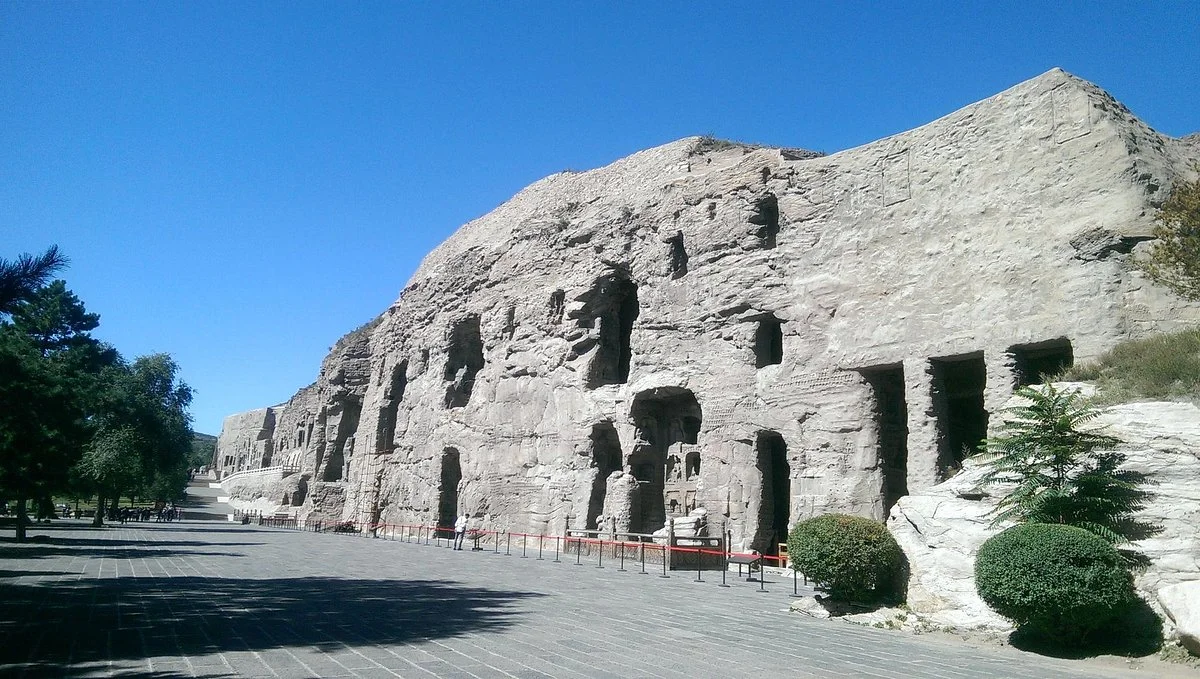
Read more See • • Yúngāng Grottoes — By far the greatest attraction of the area is the 1,500-year-old Yúngāng Grottoes, a UNESCO World Heritage Site. These mountain-side caves and recesses are filled with 51,000 Buddhist statues - the largest being a 17-metre Seated Buddha while the smallest is only a few centimetres tall. In addition to the carvings of the Buddha, there are also scenes depicting Buddhist teachings and famous monks. Unlike Dunhuang grottoes, most caves here permit photography, (notably excepting caves 5-10). The entrances to caves 5 to 10 are fronted by wooden temple structures. Caves 11-13 are under renovation. The cave walls at these entrances were damaged by graffiti during the cultural revolution although the majority of the site is well-preserved. At least you get the impression that the caves are mostly ancient/original and not reconstructed. The tour guides claim the Japanese took the statues' eyes during the occupation. — Directions: take bus #4 to the end of the line [the end of the line is just a simple stop and then the bus starts going back, ask the driver for the grottoes and he will let you know where to get off] change to #3 and take that to the end of the line. Another bus to the Grottoes can be boarded here, here or here — Price: ¥150. Full-time students and 60-69 yrs half price. Serving military, disabled, 70 and over, children under 1.4 m free. Discounts require documentary proof — Website: http://www.yungang.org/
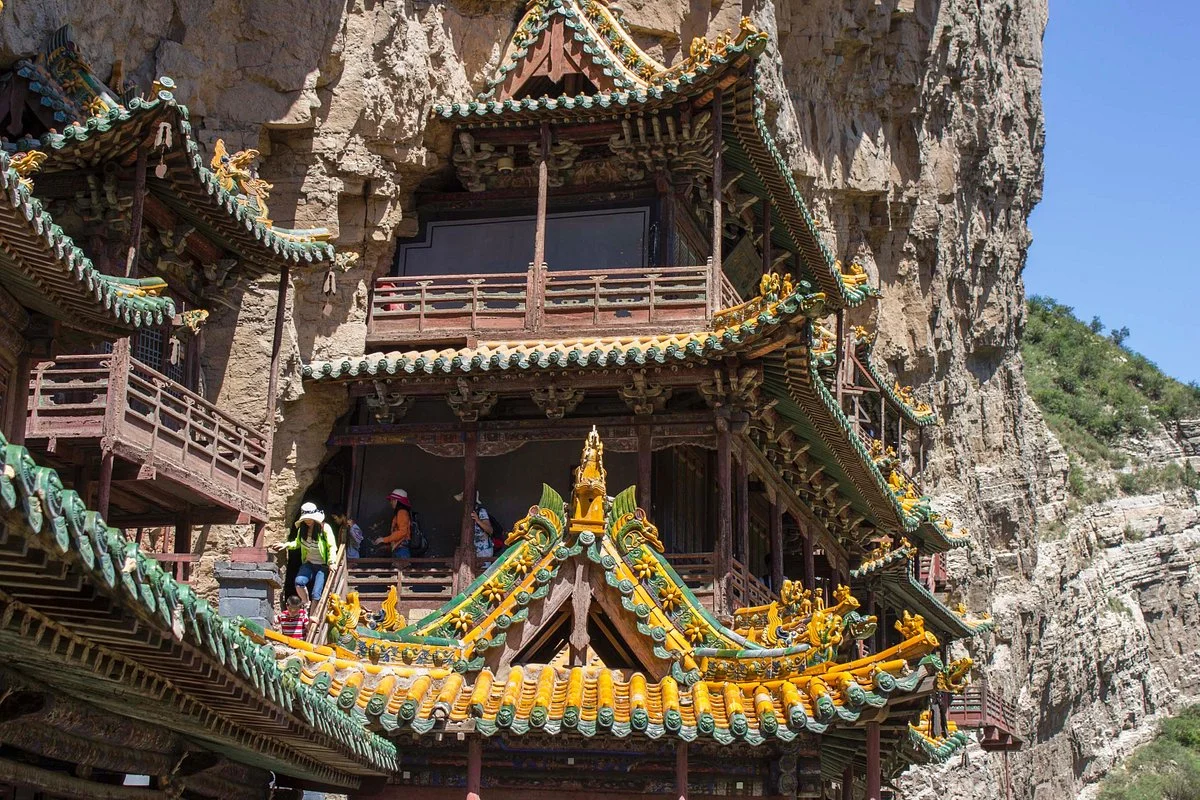
• • The Hanging Monastery — Lodged precariously on a cliff-face, this monastery is one of the more remarkable sights in China: a complex of 40 rooms linked by mid-air walkways. It appears to be stuck into the side of the cliff, but is actually supported by stilts. There is a '3 Religions Hall' with all of Buddha, Confucius and Laozi (founder of Daoism). Built in 490, renovated several times, most recently in 1900, much of the current structure dates from the Ming and Qing Dynasties. Less than an hour to visit and not for the faint of heart. The roads may be closed in winter after heavy snowstorms and it is not recommended in rainy days for the slippery ladders. The ticket checkers are supposed to only let 80 people in at a time but the monastery can be crowded as not everyone follows the same flow around. Stick to the walls! — Directions: 65 km to the southeast of Datong. From Datong train station, fifth stop on bus line 15 takes you to 市供排水集团 Shìgōng Páishuǐ Jítuán. From there, walk ahead to crossroads, turn left and main bus station 大同汽车站 Dàtóng Qìchēzhàn is just ahead on left. [May 2013 : bus station moved because of works, still take bus 15 but ask the driver for the main bus station 大同汽车站 Dàtóng Qìchēzhàn which is now around 10 stops from the train station] Window 2 sells ¥26 tickets to 悬空寺 Xuánkōngsì. Buses leave frequently. After nearly a 2 hour journey you will be dropped off in a place where you can get a taxi for the final few miles. Prices seem to vary according to how much the taxi driver thinks he'll get from you, specially in Winter when there are not many taxis available. For coming back, there are taxis when exiting the monastery that go to Datong when they are full. In winter the taxis will drop you off back at the bus station. Expect to pay 50% to 100% more than what you paid for the first leg of the trip, and expect a 50% higher price if a toot take you to the taxi. If you are not fluent in Chinese you might find it cheaper and faster to arrange the transport to and from the monastery directly in Datong's bus terminal: many taxis and vans seem to be available for hire in the morning. — Price: Entry full ¥130 summer, ¥125 winter. Students, 60-69 half price. Disabled (残疾人), military, 70 and over, less than 1.2 m tall children free. Discounts require documents.
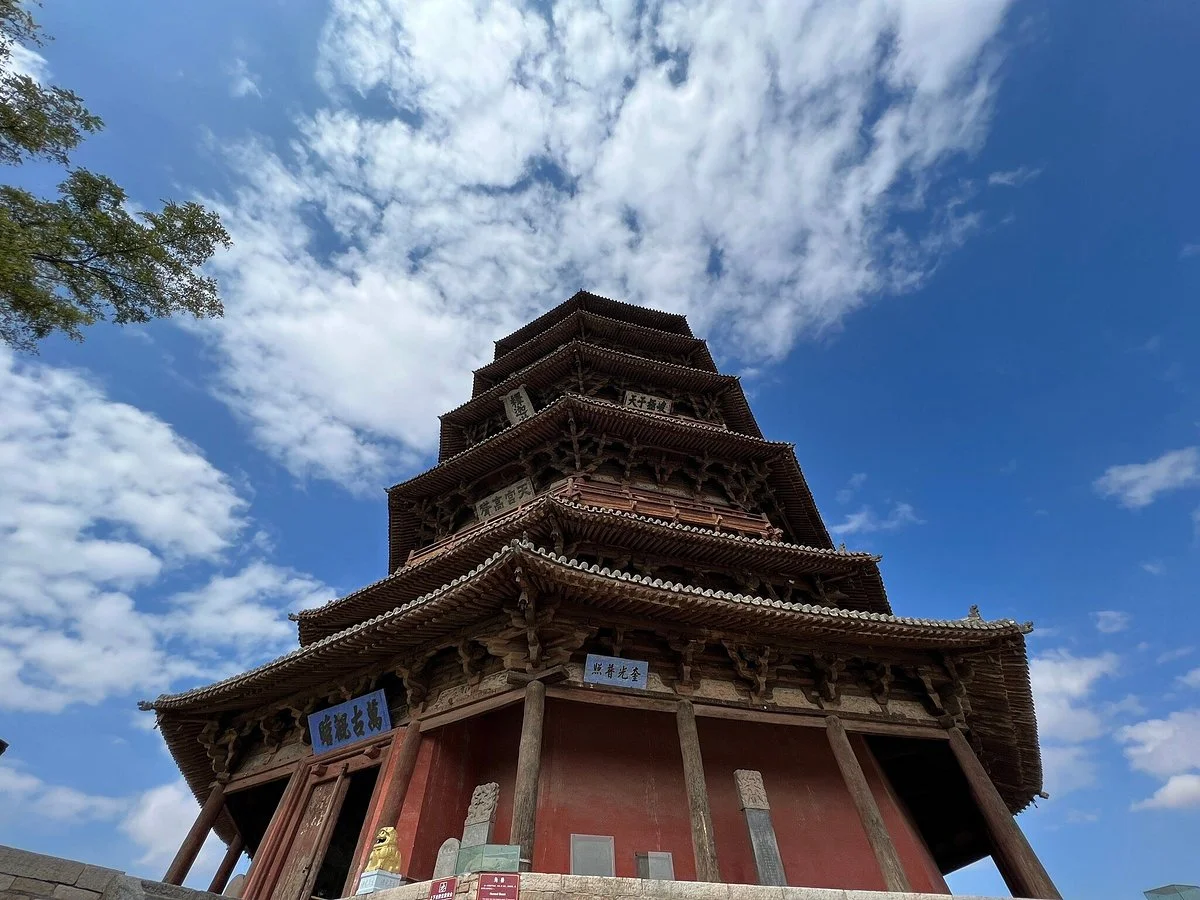
• • Yīngxiàn Wooden Pagoda — This impressive pagoda is the oldest and tallest wooden structure in China, built in 1056 in the Liao Dynasty without any sort of nails. It is located within a Buddhist temple, some of which was rebuilt in the Qing Dynasty. There is an active temple in the back built in 2001. Only the ground floor of the pagoda are open to visitors. Inside the pagoda, you can see a big Buddha statue. Maybe half an hour needed to visit. To go back to Datong, go to Yingxian west bus station which is 2 km west from this temple. Take a 3-wheel taxi, and it takes 5 min from here with ¥5. (Last bus to Datong: summer 6:30PM, winter 6PM). — Address: 应县, Yīngxiàn Town — Directions: about 75 km south of Datong and 70 km northeast of Shuozhou. The bus from Datong (¥20) takes about 2 hr, or from the Hanging Monastery (taxi to Hunyuan ¥10 after bargaining) it's about one hour (¥12) by bus, or you might find taxi drivers willing to take you directly from the Hanging Monastery car park to the Wooden pagoda for ¥40 per person — Hours: Summer 7:30AM-7PM, winter 8AM-5:30PM — Price: Tickets ¥60. Full-time students, 60-69 years old & disabled half-price. Current serving military 四,现役军人, 70 and over, less-than-1.2m-tall children free. Discounts require documents.
• • Daoist Monastery — A small collection of Daoist temples and a peaceful courtyard. A more human scale than the nearby Huáyán Monastery - half an hour at most - unless you are intercepted by a Daoist monk and have a chat or are given an explanation. Completely rebuilt in 2010. — Directions: on bus line 4 it is somewhere near stops 6 and 7, between the drum tower and Huáyán Monastery — Price: ¥30 full price. ¥15 students, etc.
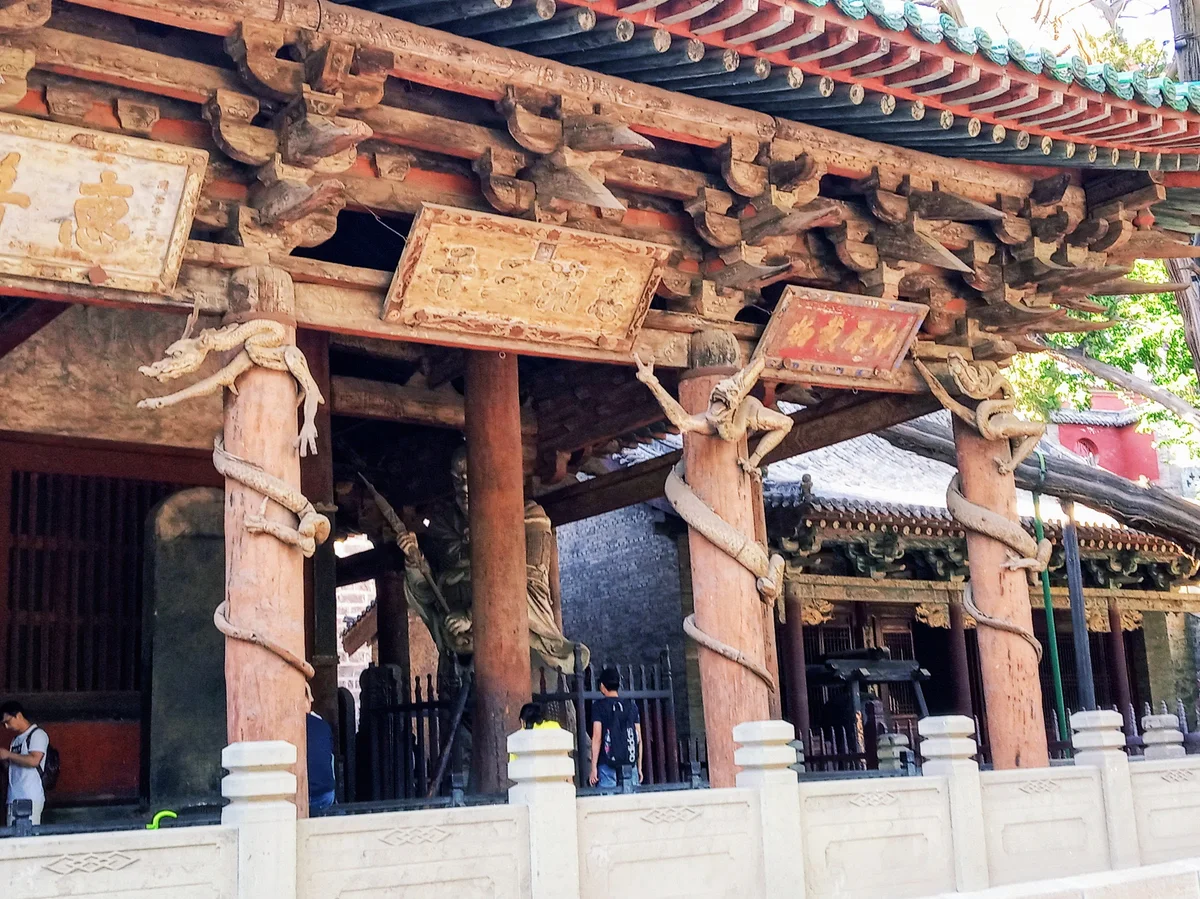
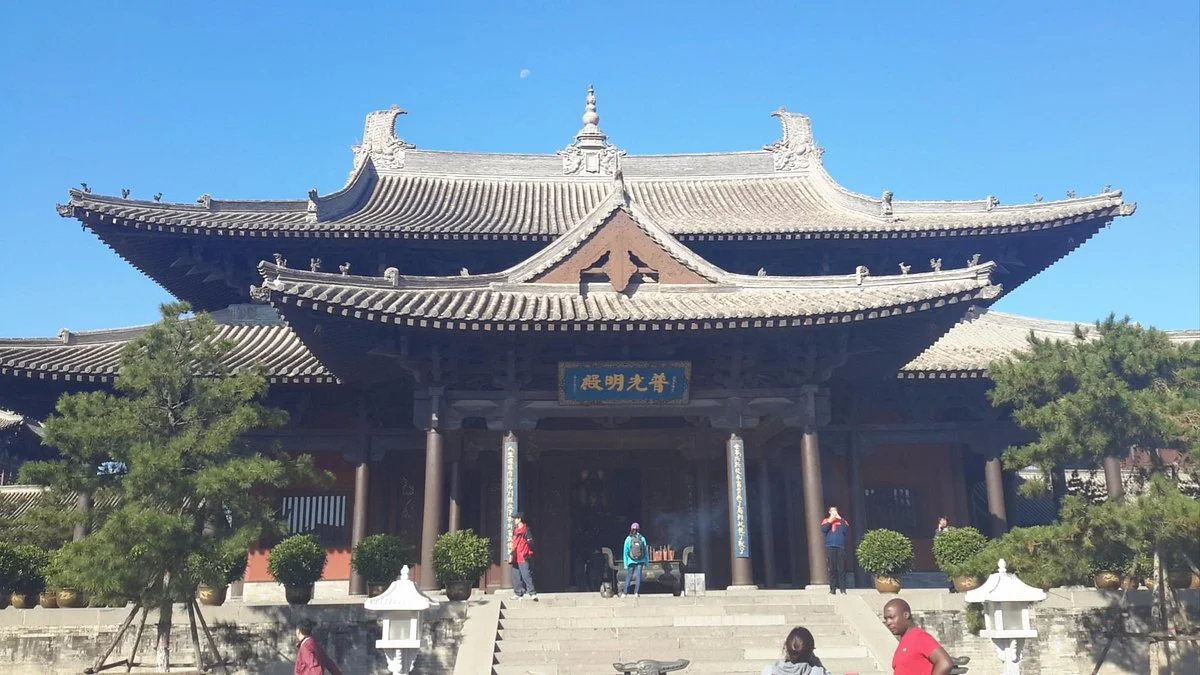
• • Huáyán Monastery — A large collection of Buddhist temples of the Huayan sect that can be seen in an hour or two. Unusually this monastery faces east, not south. Completely rebuilt in 2010. At ¥80 a bit expensive really - if you like Buddhism (and mountain scenery, and have the time), save your money/time and head to Wutai Shan for slightly longer instead. Worth seeing for the Bodhisattva with palms together and smile grinning, a special statue from the Liao dynasty. Also known for its underground palace built entirely of bronze to house the relics of a cremated senior monk. — Directions: On bus line 4 it is near the seventh stop from the train station — Hours: Closes 7PM — Price: ¥80 full price. ¥40 students. Disabled, military, 70 and over free — Website: http://www.sxdthys.com/
• • Nine Dragon Screen — A 600-year-old screen made of glazed tiles and depicting nine dragons, this is the oldest glazed screen in China. Most people will visit this for less than 5 minutes. It is a pity that the pond in front of the screen is no longer filled with water. — Address: Dàdōng Street 大东街 — Directions: at the geographic center of town, on the southern side of Dàdōng Street 大东街 (East Street) east of the main intersection a block north of the Drum Tower; it can be reached by Bus 4 from the Datong Railway Station, 6th stop 四牌楼 sìpáilóu, get off the bus and continue walking in same direction of bus and turn left at crossroads. 九龙壁 Jiŭlóngbì is on the right after 200 m — Hours: 7:30AM-7PM — Price: ¥10, students and 60-69 yrs ¥5, children under 1.3 m, current-serving military, disabled, 70 and over free. Discounts require documents.
• • Drum Tower — Like many cities in China, Datong has its own Drum Tower. This is in the centre of town, but not open to the public.
• • Heng Mountain — This is the least religiously important of the 5 Sacred Mountains of Taoism. Due to its northerly location, it has been impossible for pilgrimages by the Chinese to take place for much of its history. — Directions: The entrance gate is 2 km past the Hanging Monastery, then it's another 12 km to the scenic area. A cable car can take you directly to the temples or you can take the half hour walk — Price: ¥55 — Website: http://www.byhs.net/Index.html
• • Datong Museum — The museum covers an area of 5600 m², of which 1,800 m² exhibition area, has now become the second largest museum in Shanxi Province, 1.3 million pieces of cultural relics, a product 132. Most of the local archaeological finds. Meet the public more than pieces of precious relics in 1000, half of the initial display of rare collections. — Website: http://www.datongmuseum.com/
• • City Walls — The city walls in Datong are similar the city walls in Xi'an. This is not the ancient city wall which has long been destroyed by wars/cultural revolution. The new wall is still under construction at some parts and even replaced the Red Flag Square. Unlike the one in Xi'an, the view is not that nice and you cannot rent bicycles to go around. There are electric carts to go around but unsure if for tourists. Yanta is in the southeast corner but you cannot go up. — Address: Several entrances along the city walls - main one seems to be in the east side — Price: ¥30 full price, discounts for students available
• • Great Mosque — Nearby the drum tower and the Daoist temple.
• • Shanhua Ancient Monastery — Shanhua Temple is a Buddhist temple first founded during the early 8th century of the Tang Dynasty, but its earliest surviving building dates from the 11th century. — Address: Yongtaimennei Street — Price: ¥50 full price
Read more