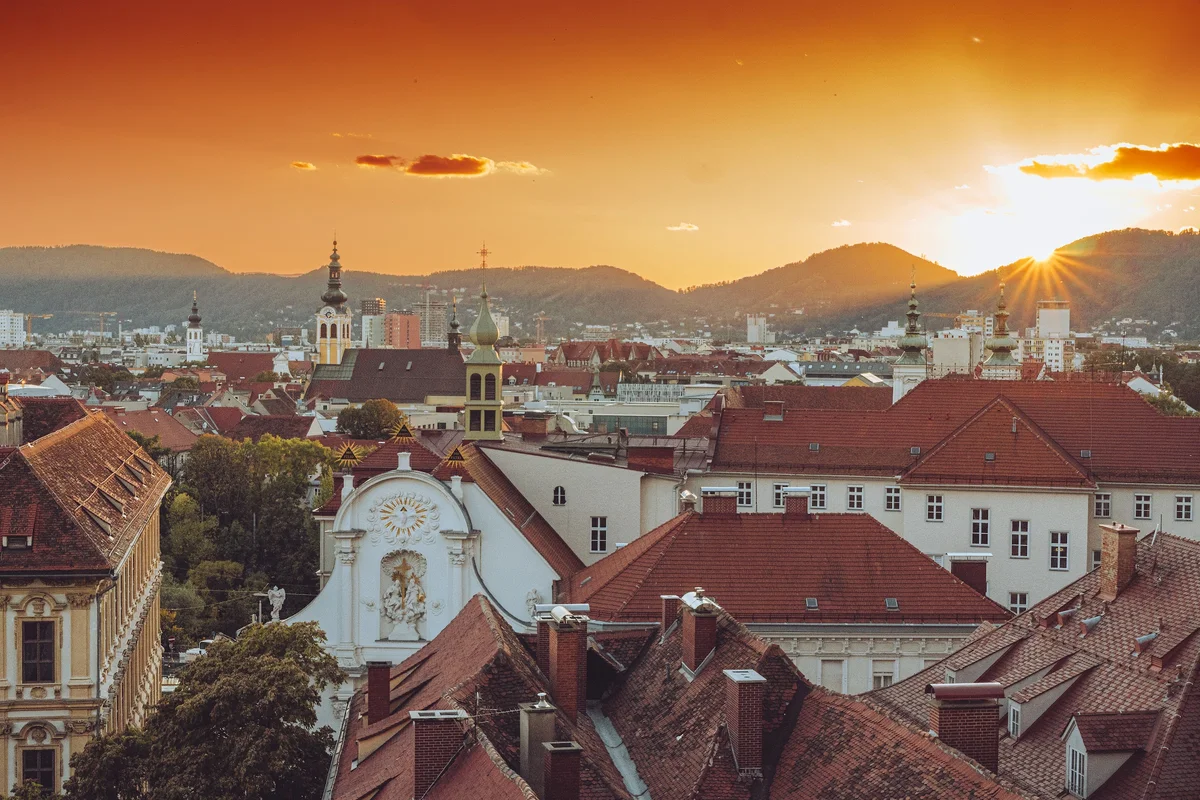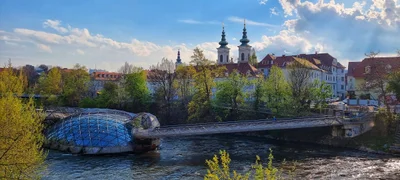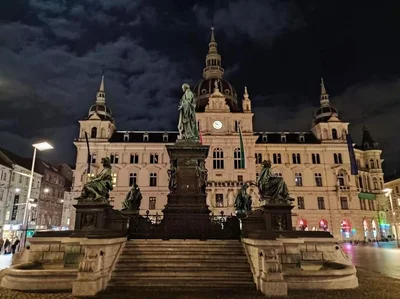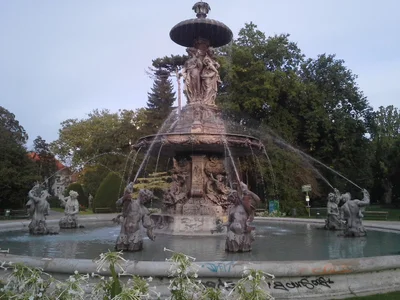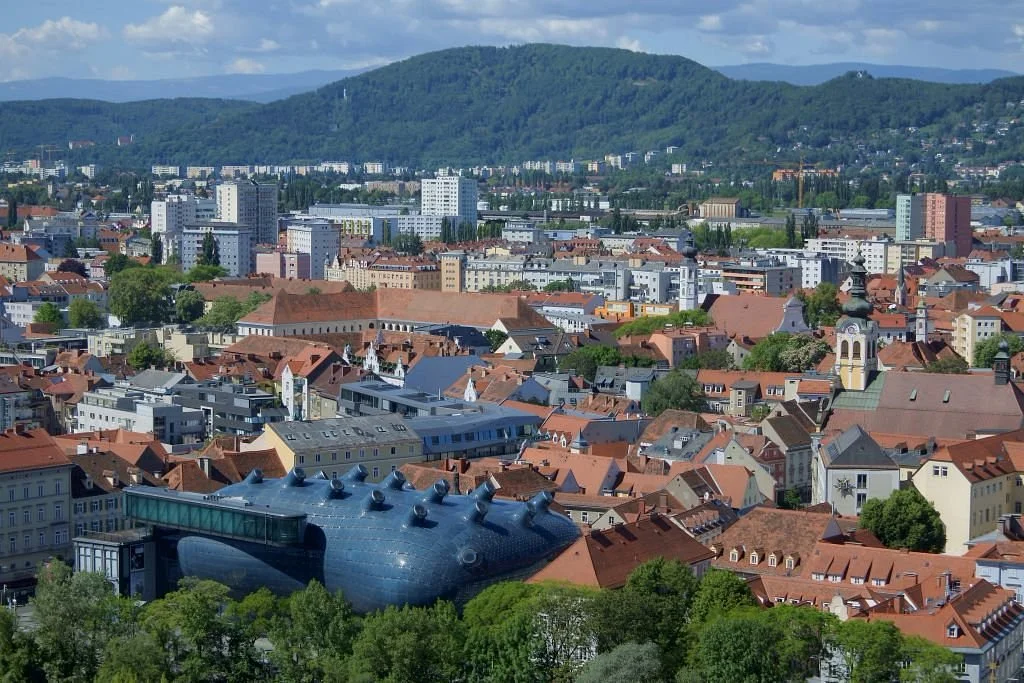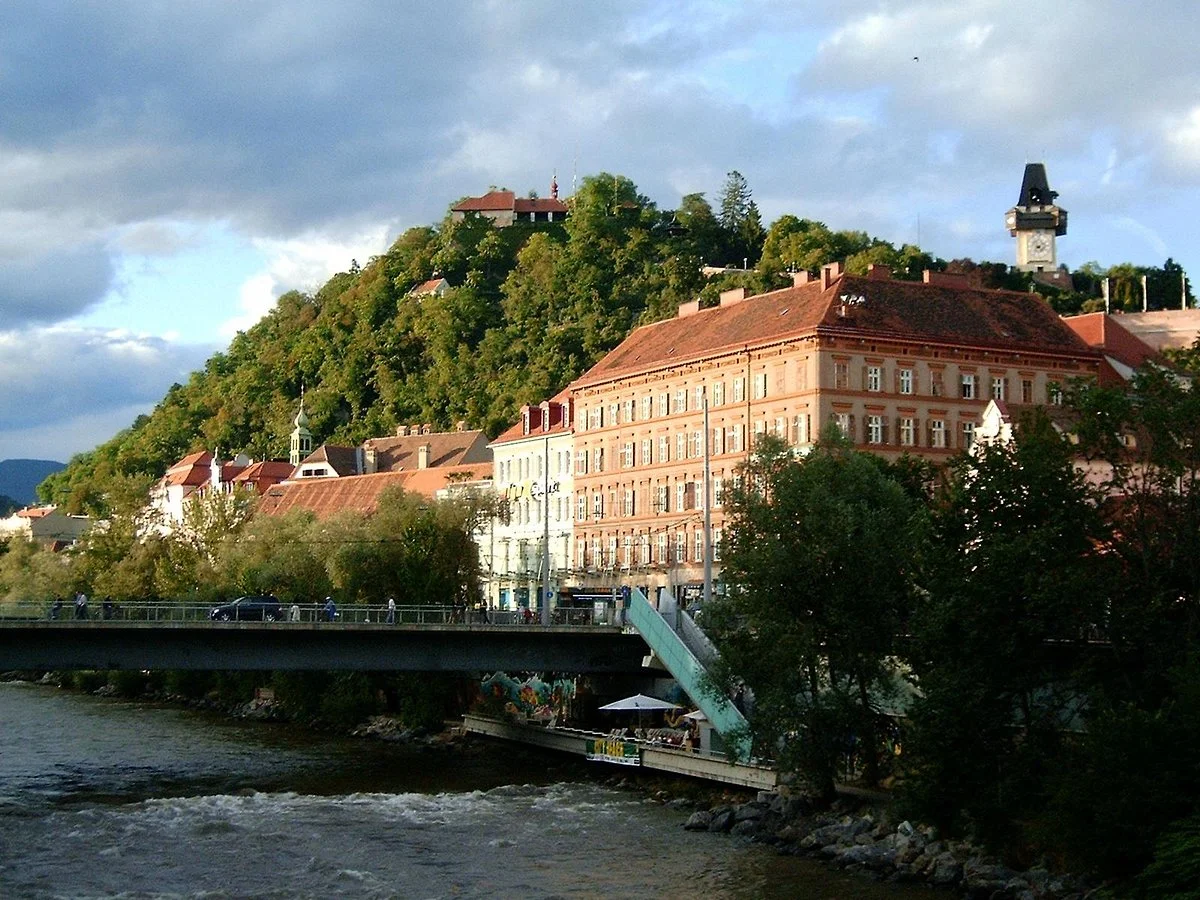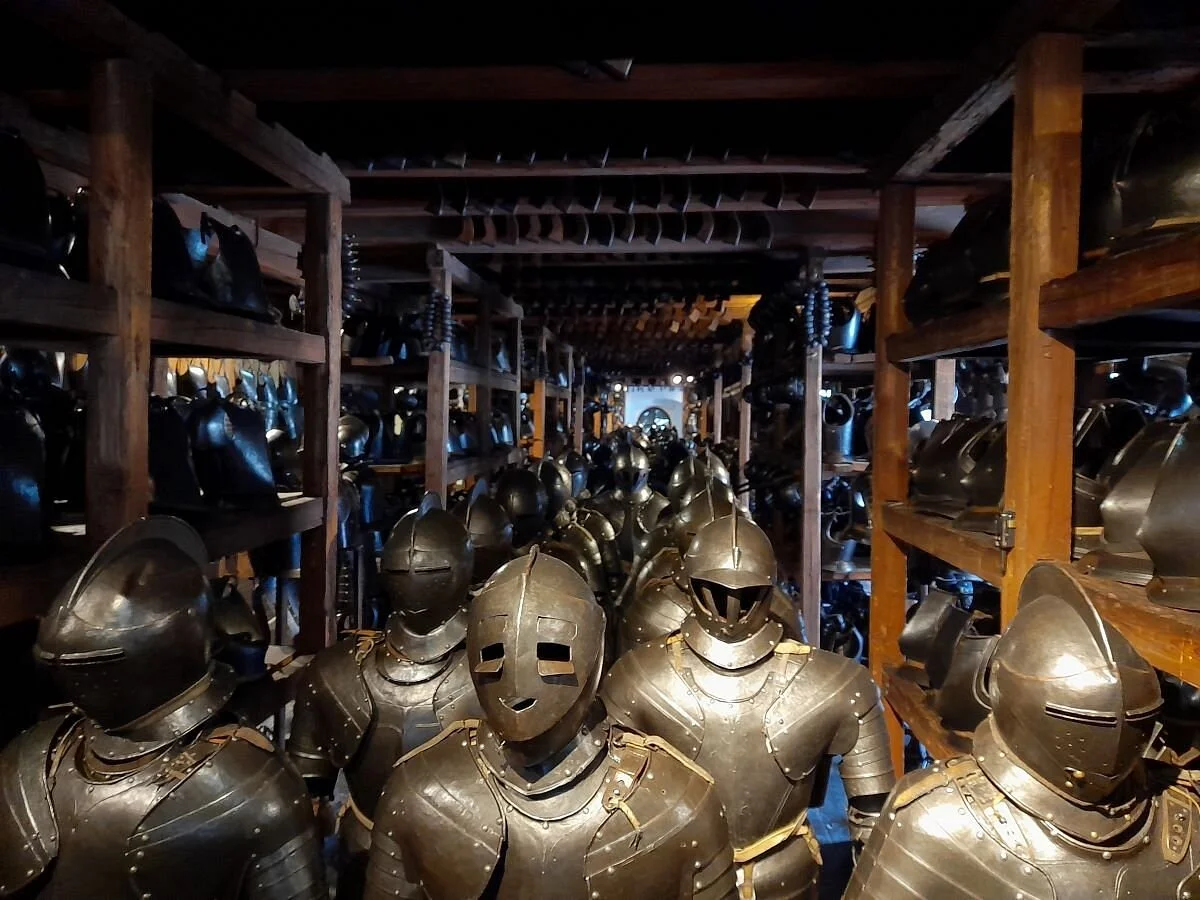
Graz (German: [ɡʁaːts] ) is the capital of Styria and the second-largest city in Austria, after Vienna. As of 1 January 2024, Graz had a population of 339,810 (303,270 of whom had principal-residence status). In 2021, the population of the Graz larger urban zone (LUZ) stood at 665,390 based on principal-residence status.
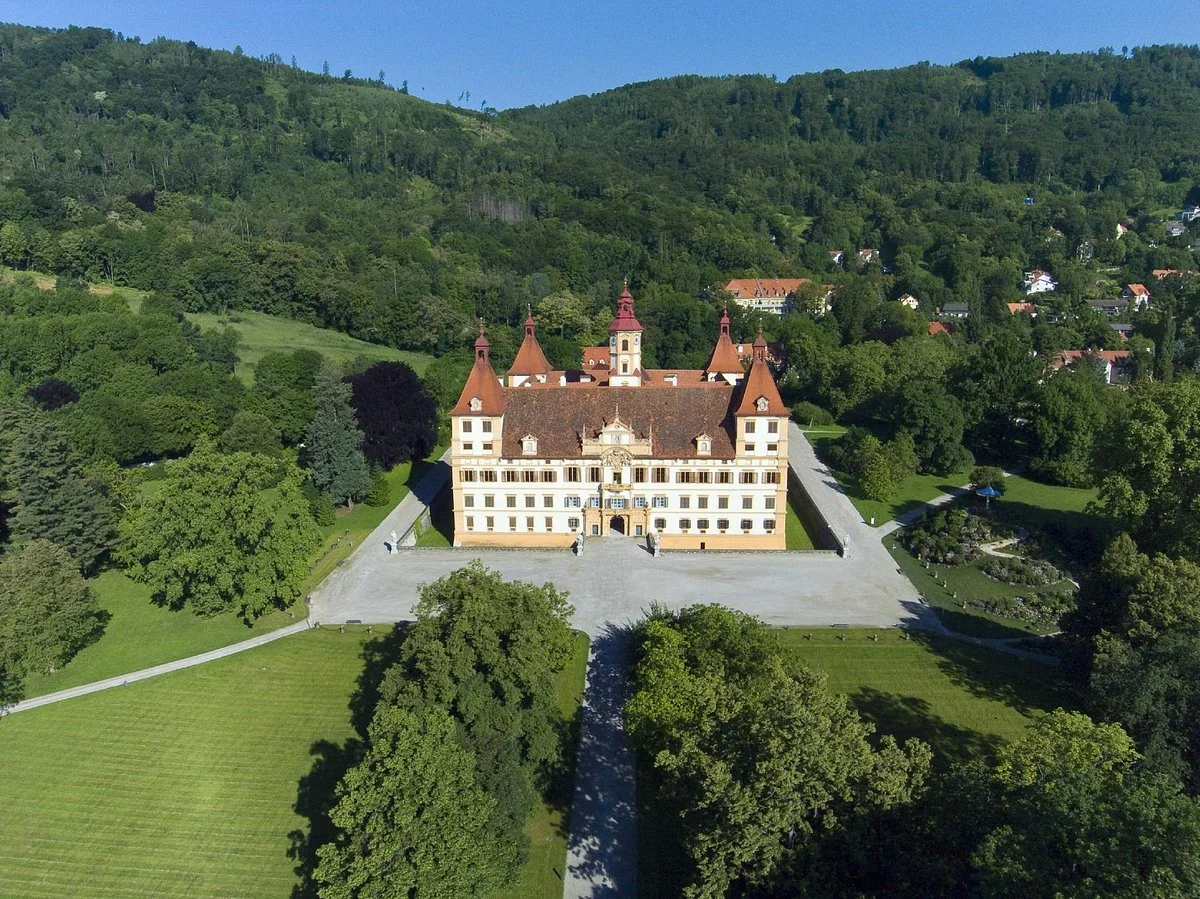
Graz is known as a college and university city, with four colleges and four universities. Combined, the city is home to more than 60,000 students. Its historic centre (Altstadt) is one of the best-preserved city centres in Central Europe.In 1999, the city's historic centre was added to the UNESCO list of World Heritage Sites and in 2010 the designation was expanded to include Eggenberg Palace (German: Schloss Eggenberg) on the western edge of the city.
Graz was designated the Cultural Capital of Europe in 2003 and became a City of Culinary Delights in 2008.
Restaurants have cheap lunch deals ("Mittagsmenü") (12:00-15:00) or a dish of the day ("Tagesempfehlung") that are usually very good, fresh and have the best value.
The SPAR supermarket in the Hauptbahnhof is the only major one open on Sunday. There are various Turkish markets around town, but their selection is limited.
Due to its importance as a university city, Graz has a vibrant night life. Bars are concentrated around the old town as well as the Karl-Franzens-University to the west of the old town. The old town has a mixed audience while the bars around university are mostly attended by students. In the old town you'll also find a few Irish pubs. Whereas the most Irish of them is O'Carolan's right next to the main square (Hauptplatz) others include Flann O'Briens and Molly Malone's. The Office is a very laidback and unique new addition to the Irish/British pub scene in Graz. The Office features regular live music and jam sessions, as well as the odd bit of Karaoke, and darts (steel - you know, the real ones from England) every Sunday.
Be sure to buy a bottle of "Kernöl" (pumpkin seed oil) in g.g.A. quality. This oil is typical for Styria and has a very unique and wonderful taste. Ideally buy it at a (farmer) market (like Kaiser-Josef-Platz, Lendplatz,...). But you can also buy good quality oil at the normal supermarkets.
There are many possibilities to go shopping in Graz. Good places to shop are: Bigger shopping complexes found outside the city centre are:
=
From the airport you have several possibilities to reach the centre:
Other nearby airports are in Maribor, Klagenfurt, and a little farther away in Linz, Ljubljana, Zagreb and Vienna International Airport. Railjet express trains and FlixBusses connect Vienna Intl. Airport with Graz. Some run direct, others require a transfer at Wien Hbf station. Travel time around 3 hr.
The old town of Graz is easily explored on foot and is reachable with a 20 min walk from the main train station. Stop at the Tourist Information at the train station, or any hotel lobby that you come across to pick up a brochure on attractions in Graz. This brochure also contains a map with most of the sights marked, as well as recommended self-guided walking routes through the town.
For other needs, public transportation options exist:
The roots of Graz can be traced back to Roman times, when a small fort was built where the city centre is today; Slovenians later built a larger fortress in the same place. The name "Graz" is derived from the Slovenian word gradec, which means small castle. Graz was first mentioned with its German name in 1128 when the dukes of Babenberg turned the place into a commercial centre. During 15th century Graz became the capital of Inner Austria (referring to Styria, Carinthia and Carniola) under the Habsburgs.
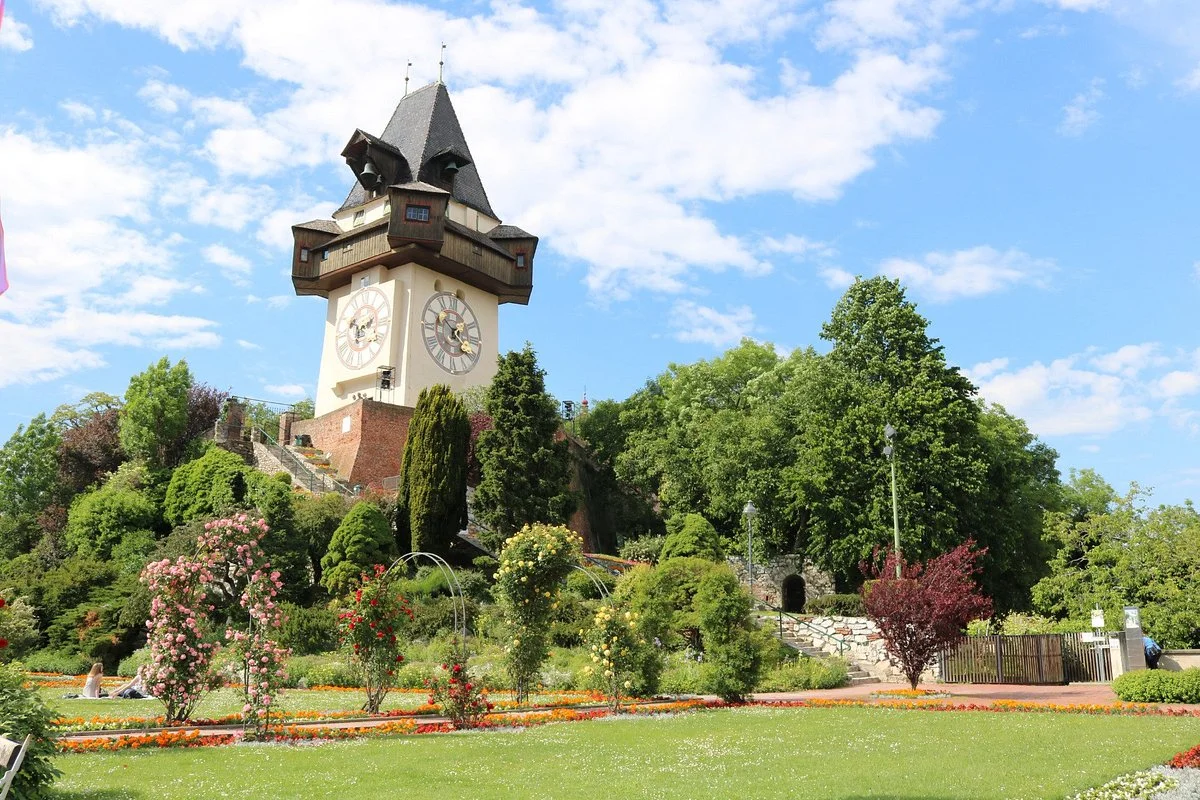
Due to its importance as a strategic position, Graz was often assaulted by Ottoman Turks in the 16th century. The fortress located on the Schlossberg (the picture to the right shows the clock tower, which is located on top of the hill) never fell to the Turks (the only place in this region).
During World War II, Graz was part of Nazi Germany (along with the rest of Austria). At the end of the war, Graz was surrendered to Soviet troops largely intact; the historic old town was not seriously hit during Allied bombing raids on the city. In 2003 Graz was the Cultural Capital of Europe.
Some 40,000 of the city's population is made up of students, as Graz is home to no less than six universities (four "standard" universities and two dedicated solely to applied sciences), and is associated with names as illustrious as Johannes Kepler, Erwin Schrödinger and Nikola Tesla. The first university was founded in 1585 (Karl-Franzens-Universität).
Graz is also known for the Magna Steyr (formerly called Steyr-Daimler-Puch) automobile and truck manufacturing plant located there. It is also the birthplace (in nearby Thal) of actor and California Governor Arnold Schwarzenegger. Its UPC-Arena was renamed in Schwarzenegger's honor in 1997, but was renamed again in 2005, following controversy over the governor's support of California's death penalty.
The City of Graz, Historic Centre and Schloss Eggenberg, is a world heritage site.