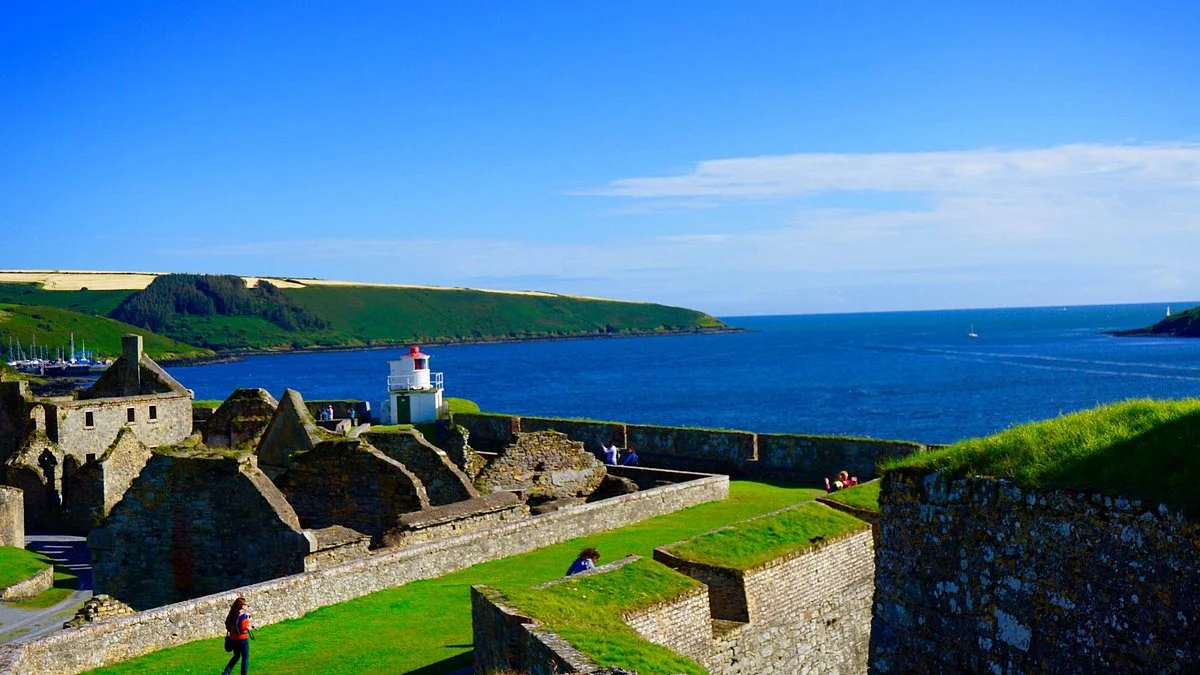
Kinsale ( kin-SAYL; Irish: Cionn tSáile, meaning "head of the brine") is a historic port and fishing town in County Cork, Ireland. Located approximately 25 km (16 mi) south of Cork City on the southeast coast near the Old Head of Kinsale, it sits at the mouth of the River Bandon, and has a population of 5,281 (as of the 2016 census) which increases in the summer when tourism peaks.
Kinsale is a holiday destination for both Irish and overseas tourists. The town is known for its restaurants, including the Michelin-starred Bastion restaurant, and holds a number of annual gourmet food festivals.As a historically strategic port town, Kinsale's notable buildings include Desmond Castle (associated with the Earls of Desmond and also known as the French Prison) of c. 1500, the 17th-century pentagonal bastion fort of James Fort on Castlepark peninsula, and Charles Fort, a partly restored star fort of 1677 in nearby Summercove. Other historic buildings include the Church of St Multose (Church of Ireland) of 1190, St John the Baptist (Catholic) of 1839, and the Market House of c. 1600. Kinsale is in the Cork South-West (Dáil Éireann) constituency, which has three seats.
: There's enough cheap and cheerful places, but for a small town Kinsale has a surprising number of excellent gourmet places.
Blacks of Kinsale distil gin, whiskey and rum, and brew a range of ales. The distillery doesn't offer tours, but you can sample their product at pubs around town.
See Cork for long distance options by rail, sea and air. Bus Éireann 226 runs hourly daily from Cork railway station, Parnell Place bus station and Cork airport, taking an hour to Kinsale. (Bus 226A only goes as far as the airport.) A standard single is €10, it's cheaper with a Leap card.
Local Link Bus 253 runs from Clonakilty via Timoleague and Ballinspittle to Kinsale. There are 5 M-Sa and 3 on Sunday.
By car from Cork take N27 towards the airport then R600 to Kinsale. From Bandon, take N71 towards Inishannon, then R605 to Kinsale.
at the foot of Market Square is also the turnaround stop for the buses.
Walking should get you everywhere.
Local taxi companies are Kinsale Cabs +353 21 470 6853, and Cab 3000 +353 21 477 3000.
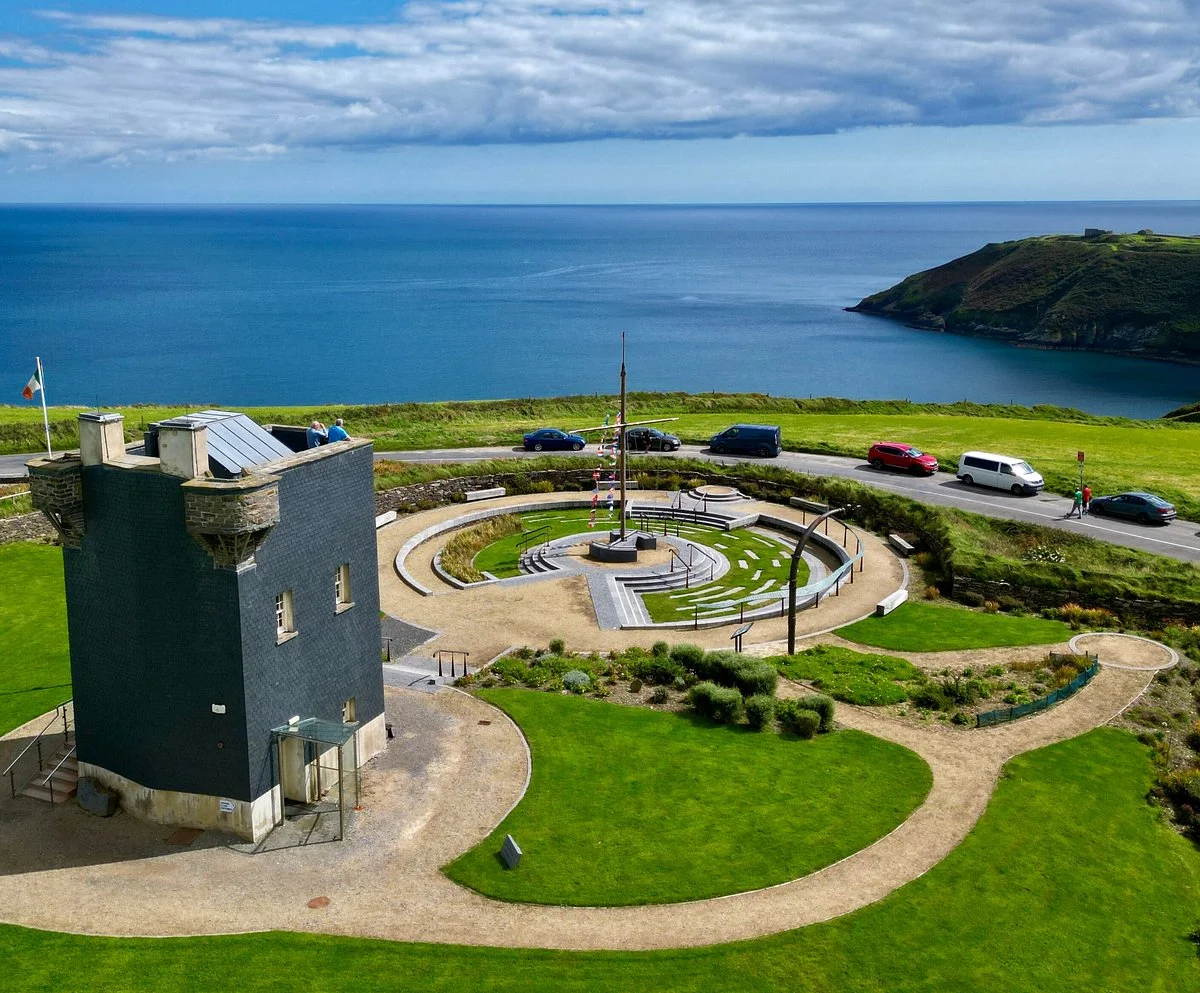
Kinsale is a small sheltered harbour in the estuary of the river Bandon. It's popular with amateur sailors and sea-anglers, but is too small for ocean-going ships. But in bygone centuries with small craft, it was well-positioned for trade with France and Spain - and for dodging the attention of English warships patrolling the western Channel.
By 1600 the English controlled most of Ireland but the O'Neills of Ulster remained the last Irish opposition. They called for support from the Catholic continent and Spain weighed in. Several naval expeditions were beset by storms but in 1601 they managed to land troops at Kinsale - the wrong end of the country to help the O'Neills. They became bottled up there so the Irish marched south to join them and break the English siege. They were routed in the battle of 24 Dec 1601; the Spanish remained besieged for three months then surrendered, and were allowed to sail home. Irish rule was broken.
Another continental caller in 1689 was King James II & VII, ousted from the English throne but strongly supported in Ireland. He landed at Kinsale with French troops and marched north, to be beaten at the Battle of the Boyne. He scarpered down to Wexford then to Kinsale where he fled to France, leaving his Irish supporters to fight and die for a lost cause. So in terms of regnal number, that made him James II of England and Wales, VII of Scotland, and Séamus an Chaca of Ireland - "James the Shit".
In 1703 a band of privateers left Kinsale to attack Spanish shipping, and among them was Alexander Selkirk. After a year of storms and battles in the Pacific his ship was in a bad way, and he declared he'd rather be put ashore than continue in it. The captain left him on what we now call Robinson Crusoe Island, and sailed on to have the ship sink under him. Selkirk spent five years as a castaway, and altogether had a more lurid life than the mercantile hero of Daniel Defoe's novel.
The English built up their navy facilities here but Kinsale harbour was too small for late-18th century vessels, let alone the metal steamers of the Victorian age, thanks to the sandbar at its entrance and the rocks known as "The Sovereign's Bollocks". So it was never a major port of emigration, and didn't attract industry and development; the navy base moved to Cork. This means that Kinsale's higgledy-piggledy narrow old streets have been preserved, lined by colourful houses.
The Tourist Information Office is by the main town car park and bus stop on Pier Rd. It's open Tu-Sa 09:00-17:00.