
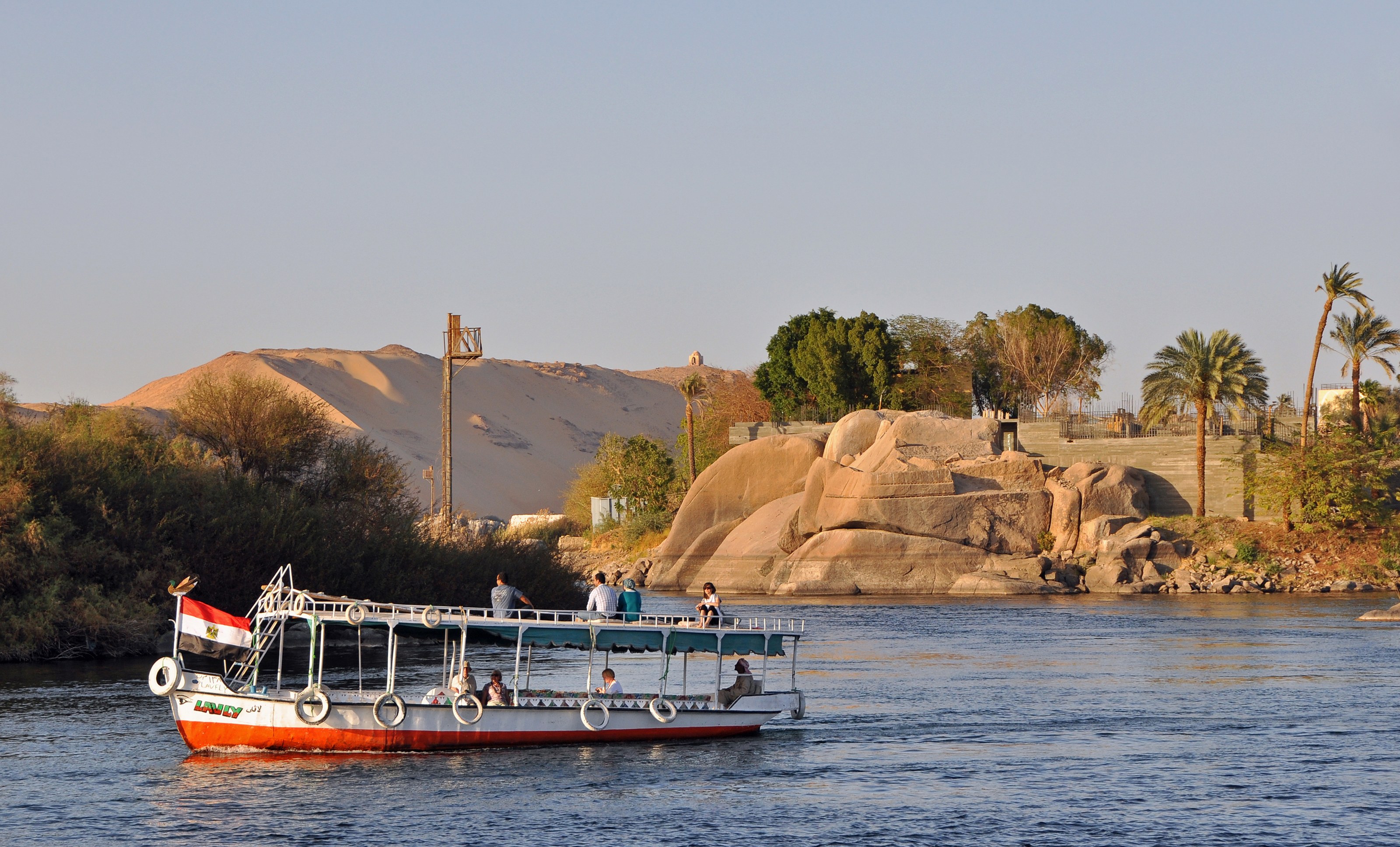
The most useful thing to bring to Aswan's riverbank is a question: what, exactly, are you looking at? Water and stone are the obvious answers. A boat crosses the foreground; palms and buildings interrupt the bank. But a view of the Nile is also a view into decisions about power, preservation and the ways people describe home. Begin with the scene, then resist making it explain everything. The river deserves more than the familiar adjective timeless. Here, a little historical precision makes looking more interesting.
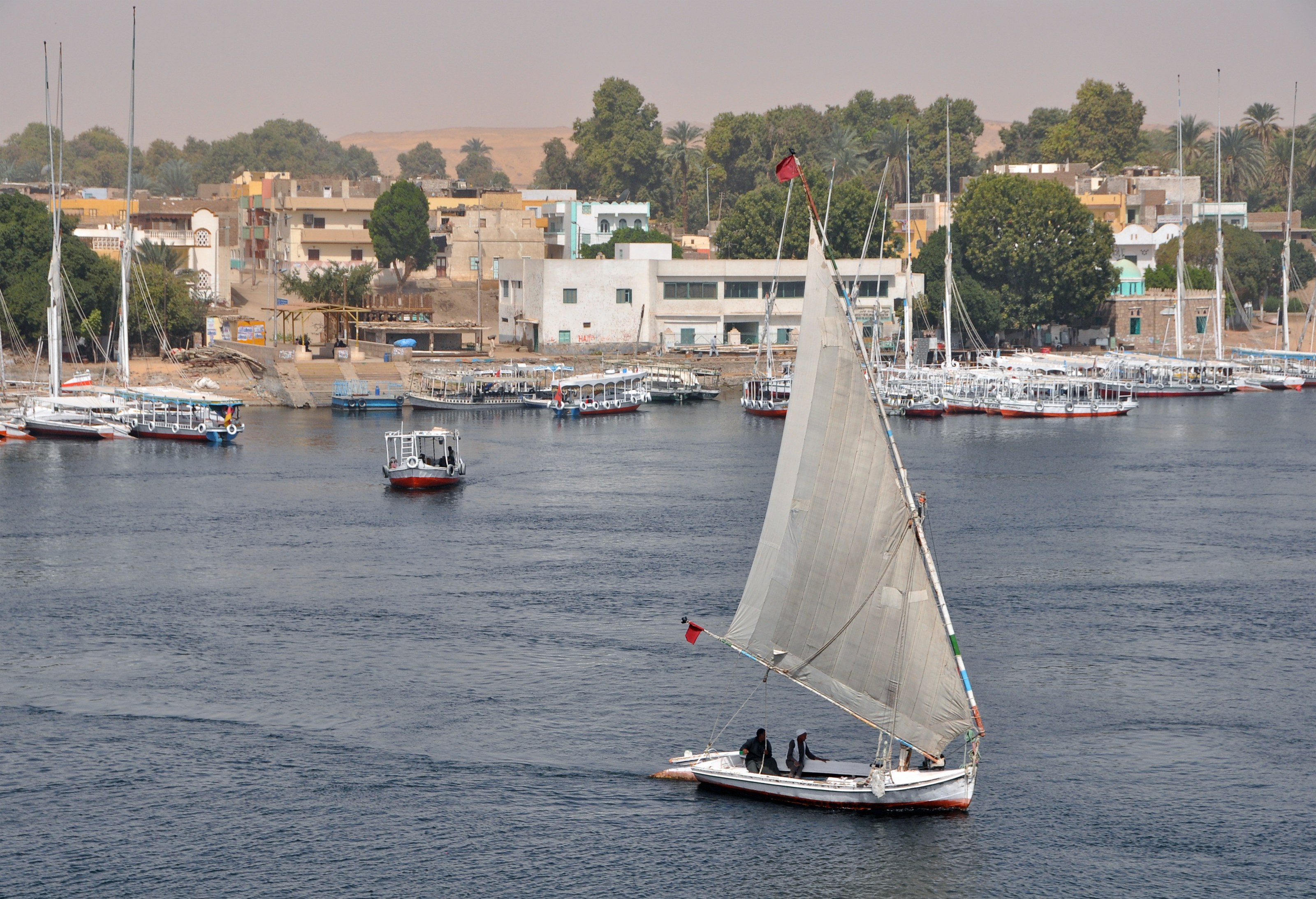
Our two photographs hold a particular moment: March 2012. In one, a passenger boat passes rocks beside Elephantine Island; in the other, a sail cuts a triangle against the opposite bank. They are useful for noticing the different scales of the landscape, from the width of a boat to the outline of an island. They cannot tell you which service runs today, where to board it or what a crossing costs. Treat the pictures as an invitation to pay attention, not as instructions for reproducing the frame.
Start with context
A visit to the Nubia Museum offers a good counterweight to sightseeing by silhouette. Opened in 1997, it grew out of the international effort to safeguard Nubian heritage. Its remit includes archaeology, culture and environment, rather than presenting the region solely as a collection of monumental remains. The museum's account also describes reconstructed domestic space and a garden waterway. This is a useful place to begin thinking about the relationship between a river and the lives arranged around it.
Allow yourself to stay with a small selection of objects. Read their dates and places of origin before deciding what connects them. An object labelled with a location is not simply a representative of an undifferentiated past; it belongs to a particular account. If the sequence becomes confusing, return to the map or chronology. You will gain more from understanding one relationship properly than from gathering a blur of beautiful surfaces. This is an editorial way of approaching the galleries, not a prescribed museum route.
Carry that distinction outside. Archaeology can illuminate a landscape without giving a visitor authority to summarise the people living in it. Avoid treating contemporary Nubian identity as scenery left over from antiquity. If you want a fuller account, seek out appropriately qualified local interpretation and ask whose experience a particular story represents. A guide can explain a site; no single guide, display or afternoon can stand in for every household. The rewarding question is often not what has remained unchanged, but how a place has been understood differently over time.
An island remade
Philae sharpens that question. The temple complex, associated especially with the goddess Isis, now stands on Agilkia Island. UNESCO dates the movement of the Philae monuments to 1972–1979, within the wider Nubian rescue campaign of 1960–1980. The distinction matters: the date of the international campaign is not the date of every individual relocation. The High Dam and its reservoir formed the setting for an extraordinary effort to move threatened monuments. The place encountered today includes both ancient construction and modern conservation.
That does not make the encounter less authentic. It changes what authenticity asks of us. Rather than imagining that stone has occupied one position without interruption, consider the work involved in deciding what to preserve and how to present it. A monument can carry evidence of ancient belief while its setting carries evidence of twentieth-century priorities. Neither cancels the other. Seen this way, the approach to Philae is not merely an attractive prelude to architecture; it is part of the subject.
The engineering story is also not a complete social history. A successful account of saving stone cannot, on its own, answer every question about the human consequences of changing a river. Keep those strands distinct when listening to interpretation or reading afterwards. It is possible to admire the ingenuity of conservation while recognising the limits of what a monument-focused narrative covers. You do not need to resolve that tension during a visit. Noticing that it exists is already a better starting point than calling the whole scene eternal.
The crossing is a decision
Water transport should be planned with the same care as admission. Do not infer a boat's destination from its appearance, or assume that an agreed outward trip includes the return you have in mind. Before committing, establish the departure and landing points, the total charge, waiting arrangements and what happens if the plan changes. Ask about appropriate safety equipment and boarding assistance. These are questions to put to an operator, not assurances about a particular vessel. No boat company or current sailing is endorsed here.
The UK's travel advice records accidents associated with overcrowding and poor safety standards on Nile cruises and Red Sea ferries. That is a reason to make a considered choice, not to treat every vessel as interchangeable. Check the advice applicable to your nationality and circumstances, and confirm that insurance covers your intended activity. If equipment, boarding or conditions leave you uncomfortable, stay ashore. A river-centred visit does not require a river journey, and a photograph is never a reason to accept a crossing you would otherwise decline.
Separate Philae from an unstructured Corniche walk in your planning. They are not interchangeable ways of filling the same spare hour. Check the temple's current access and admissions arrangements, organise transfers with room for delays, and avoid building a day around the final possible entry. For the museum, too, distinguish opening hours from the ticket window: an advertised closing time is not permission to arrive at the door just before it. Confirm the current details before setting out rather than relying on the times attached to an old photograph or itinerary.
Look without collecting
Back beside the Nile, set a modest task: choose one safe public position and stay there long enough to separate the foreground from the distance. Notice which parts of the view belong to transport and which to the shore. Let a boat pass out of the composition instead of following it with the camera. The exercise is not a claim that the river moves at a special, more virtuous pace. It is simply a way to stop converting every visible thing into the next item on a list.
People do not become public subjects because they are near a famous landscape. Ask before making a recognisable portrait, and accept a refusal without negotiation. Keep clear of boarding areas and people's work. If a view includes a doorway, a home or someone resting, consider whether the photograph needs them at all. Often the more thoughtful picture is also the more precise one: a relationship between a bank and a vessel, a patch of shade, a change in the surface of the water.
Give the day a landward margin. Arrange drinking water, rest and a return journey before you are tired, and be realistic about the amount of outdoor walking that suits you. Travellers with mobility needs should ask separately about museum access, transfers and boat boarding; a reassuring answer about one does not settle the others. Keep funds for transport distinct from admission costs. The practical details are not obstacles to appreciating the place. They are what let you give it your attention.
Aswan rewards this alternation between looking and checking. A museum adds context to the bank; a relocated temple complicates the apparent permanence of stone; a dated photograph reminds you that your own view will also belong to a moment. Leave with questions that have become more specific. Which account helped you understand what you saw? What remains outside its frame? The Nile need not become a metaphor for all of history. It is enough to encounter it as a river around which history has been made.
“The river deserves more than the familiar adjective timeless.”
A considered route
- ContextNubia Museum
Use selected objects and their geographical context to begin the visit.
- Plan separatelyPhilae
Arrange access and transfers in advance; understand the relocation to Agilkia.
- ReturnThe Corniche
Choose a safe public viewing position and leave working landing areas clear.