
A waterfront can make a city appear simple. Put the buildings on one side, the water on the other, and the map seems to offer a ready-made walk. Montevideo's Rambla invites that first reading, then quietly complicates it. The expanse is the Río de la Plata, not the open Atlantic. The edge is a work of urban design, not merely the point where construction happened to stop. And a route that looks continuous on a screen is still made of particular crossings, surfaces, neighbourhoods and weather.
Begin by choosing a section, not by promising yourself the whole waterfront. The useful unit is an afternoon with a comfortable way home. Ramírez Beach and Rambla Sur offer different starting points for thinking about the relationship between city and shore; they need not become compulsory consecutive stops. Decide whether you want to spend time beside a beach or examine the harder urban edge. Give that choice room. A successful walk is not measured by the length of blue line beside it.
A coast with a construction history
Rambla Sur was officially inaugurated on 30 December 1935, with its definitive urbanisation plan following in 1947. The municipal tourism account describes a transformation of roughly thirty blocks between Reconquista and the water, involving homes, small beaches, streets and quarries. That history changes the way the spaciousness reads. What looks like a generous opening towards the horizon also belongs to a story of removal and reconstruction. The waterfront is both something the city gained and a reminder that urban improvements are never made on a blank sheet.
Carry that knowledge lightly rather than turning the walk into an exercise in imagined reconstruction. Unless you have a reliable historical map, do not assign a vanished house or street to a precise patch of pavement. Instead, ask the larger question that the evidence supports: what does a city make visible when it redesigns its edge, and what becomes harder to see? A promenade may be visually direct while its history is anything but. Looking at the present does not require forgetting how it was assembled.
There is pleasure in understanding a public space as a made thing. Notice how a boundary directs your body: where it encourages a pause, where it keeps movement going, where a road places a negotiation between the neighbourhood and the water. The view is only one element. A bench, a crossing and a sheltered place to stop can shape a visit more than a famous panorama. These are details worth evaluating for your own route, without assuming that every stretch offers the same facilities.
Two photographs, two conditions
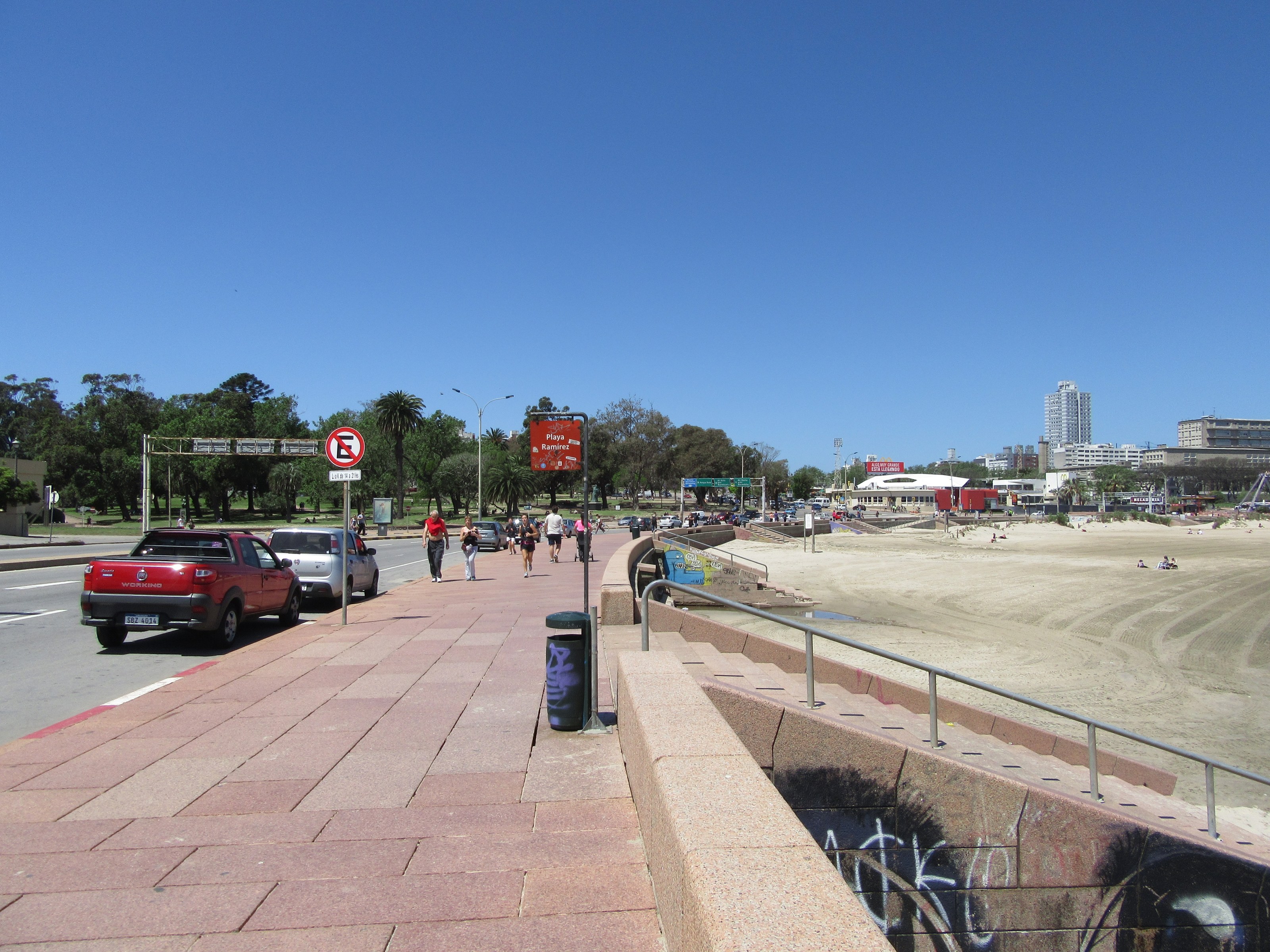
The photograph beside Ramírez Beach dates from December 2016. It includes pedestrians, traffic, paving and sand in the same frame. The frame keeps the waterfront visibly connected to the city. Read that mixture as a useful reminder to expect an urban outing rather than an isolated beach escape. The picture records one place on one day; it is not evidence of today's beach condition, traffic arrangement or accessibility.
Our second archive image, also from December 2016, shows storm waves beside Barrio Sur. It belongs here because the shoreline is not always a benign backdrop. Its drama should not become an itinerary. Uruguay's emergency guidance advises keeping away from the coast during storms associated with heavy rain and strong winds. Check current official warnings and change the plan when necessary. Staying inland is a legitimate waterfront decision, even when the photograph that brought you here was taken close to the water.
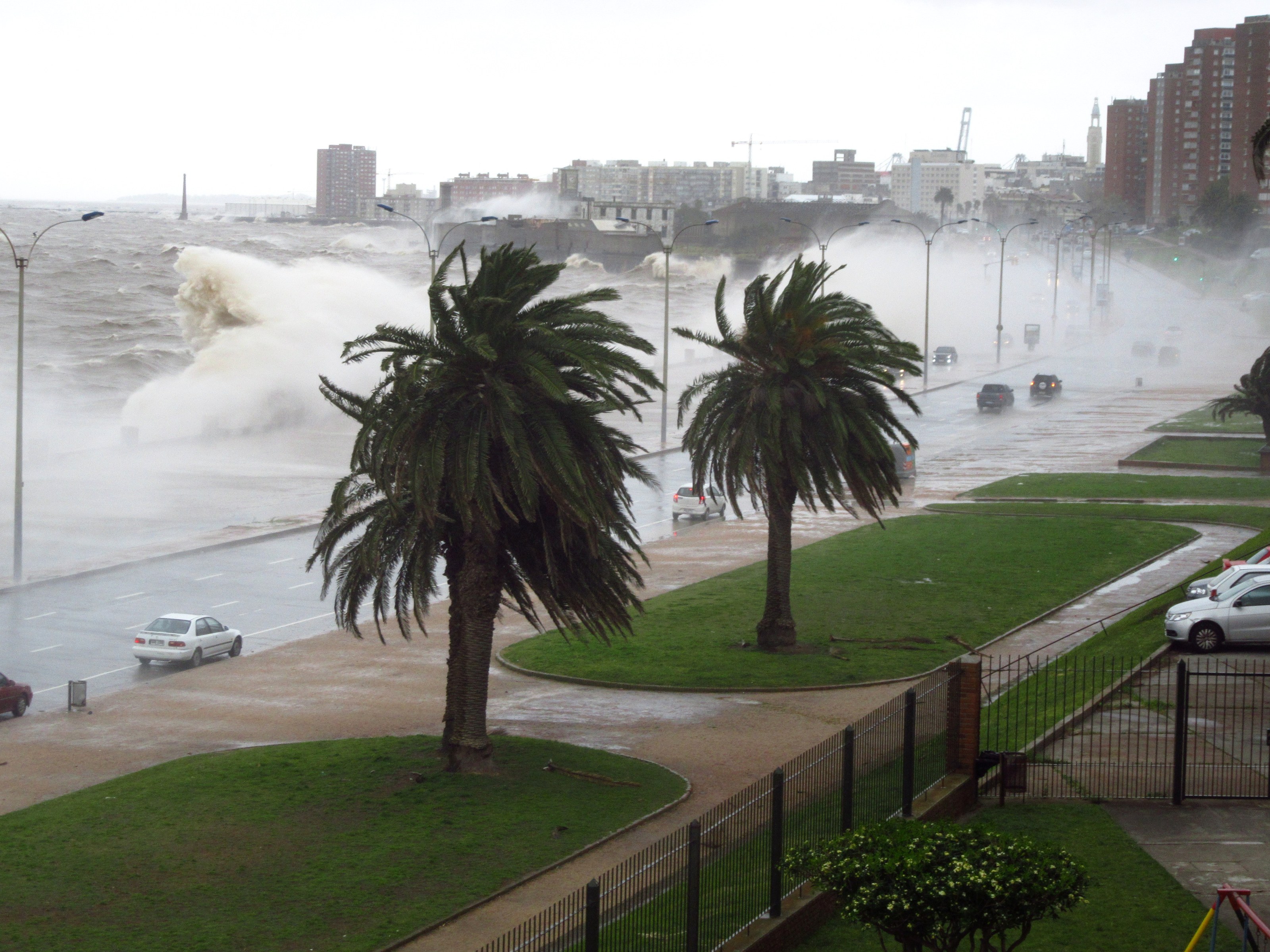
The contrast between the two images is more instructive than a promise of perfect weather. A familiar destination can have very different practical meanings under different conditions. Before leaving, look at the forecast for the hours you intend to be out, not simply the day's symbol. Decide where you would turn back or leave the shore. Do this while the choice is easy. An attractive horizon has no obligation to remain comfortable for the duration of a walk.
Leave swimming out of the default plan
Being beside a beach and entering the water are separate activities. Montevideo's municipality provides information about beach conditions and water quality, with seasonal lifeguard arrangements and sanitary warnings. Consult the current official information and any flags or instructions on site. Do not infer safety from the colour of the water, the number of people on the sand or the absence of a lifeguard. Monitoring, supervision and your own swimming ability answer different questions; none should be silently substituted for another.
This story proposes a shore-based visit. That keeps the afternoon flexible without making claims about which beach is suitable for bathing on an unknown future day. If swimming matters to your trip, plan it separately and verify the relevant conditions close to the time. A broad destination label is too blunt an instrument for that decision. The same restraint applies to photographs: a summer beach scene is a record, not a certificate.
Water also changes the way distance feels. With a clear line ahead, it is easy to keep extending a walk until the return becomes the less enjoyable half. Choose a turning point in advance and allow yourself to revise it earlier. Bring what you need for exposure and comfort, and arrange transport independently of the ambition to walk. This is practical pacing advice rather than a timed route. No fixed distance or universal walking speed can account for everyone in a group.
The city is still beside you
Look landward occasionally. A waterfront outing can otherwise become a long session of showing the city your back. Consider how you reached the shore, and which streets you will use to leave it. Cross at appropriate designated points rather than treating the view as permission to drift across traffic. If you pause for a photograph, step out of the flow of movement first. The space you are admiring is also being used by people who are not on holiday.
A public promenade is not a performance staged for visitors. Avoid turning passing walkers, people exercising or a private conversation into evidence of an essential national character. There is no need to caption a stranger's ordinary afternoon as a lesson in how to live. You can appreciate the availability of shared space without inventing the thoughts of those using it. The more modest observation is often the truer one: here is a part of the city where you can spend time without needing a ticket to look at the water.
For travellers with access requirements, check the precise segment and arrival point rather than relying on the word promenade. The municipal listing combines a description of broad circulation with limitations in its accessibility information. It does not justify a blanket claim that every approach, kerb or facility will suit every visitor. Ask about surfaces, crossings, toilets and places to rest that matter to your journey. A short, well-understood section can offer more freedom than a long route built on assumptions.
Leave room for a meal away from the edge, with no insistence that it come with a view. A waterfront can be the centre of an afternoon without having to supply every part of it. Keep your return plan and a little spare budget in mind, then let the outing remain open enough for an unplanned pause. The point is not to manufacture leisure perfectly. It is to avoid making an uncomplicated pleasure depend on a complicated sequence of commitments.
Montevideo's shore becomes more interesting when its apparent simplicity is allowed to fall away. It is an estuary frontage, a constructed boundary, a changing weather exposure and a shared urban space. None of those readings diminishes the pleasure of facing the water. Together, they give that pleasure a location. You can leave without completing the Rambla and still have encountered it properly: with a clearer sense of what the city has made at its edge, and of the attention that edge asks in return.
“A promenade may be visually direct while its history is anything but.”
A considered route
- ChooseOne shoreline section
Select a suitable starting point and return plan before setting out.
- LookThe made edge
Consider the relationship between paving, traffic, neighbourhood and water.
- PauseLeave the waterfront
Build in rest and a meal without requiring the full afternoon to stay at the shore.