
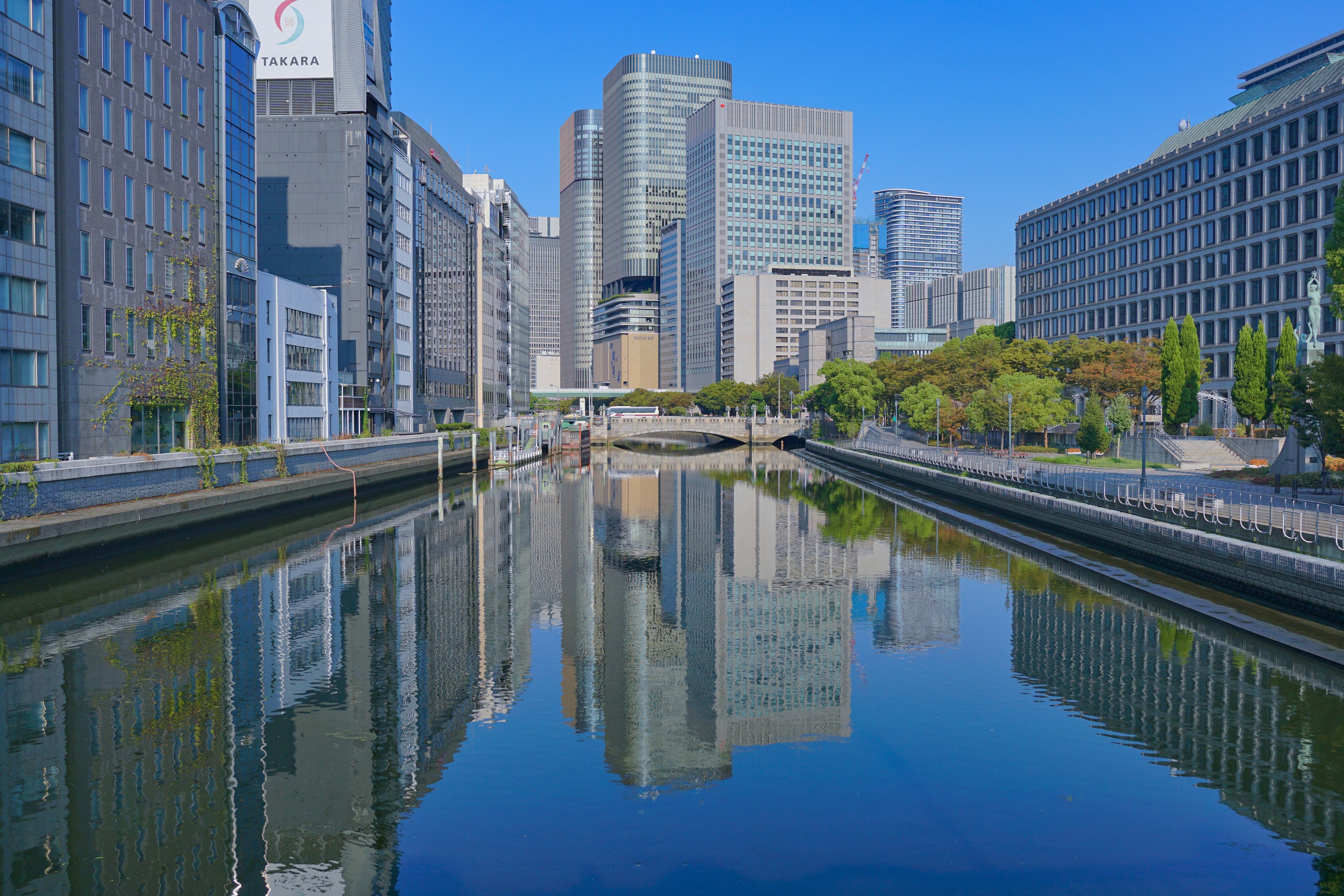
From a bridge over the Tosabori River, an office façade acquires a second life. Its straight lines become a wavering arrangement on the water, close enough to recognise but impossible to hold still. Osaka is often introduced through the density of its signs, shops and places to eat. Nakanoshima offers another entrance: a length of city in which the gap between buildings matters as much as the buildings themselves. The water gives you somewhere to place your eye before choosing what to look at next.
There is no need to claim this quieter view as the real Osaka. A commercial street and a riverbank are parts of the same city, not competitors for authenticity. Make an afternoon of the eastern part of Nakanoshima, with the option to stop early. You will get more from two or three attentive crossings than from marching the entire waterfront in pursuit of completeness. The route is a framework for looking, not a test of distance.
An island within the working city
Nakanoshima lies between the Dojima and Tosabori rivers. Japan's National Diet Library describes its origin as a sandbar and dates Nakanoshima Park to 1891. Those simple facts help make sense of the ground beneath the civic buildings and planted spaces. This is a place defined by two edges, with bridges connecting it to the streets around it. To see the island only from inside is to miss how much of its character depends on the views across water.
Begin by distinguishing the river names on a map. Then identify your arrival station and a different point at which you could leave. The Osaka tourism bureau lists Yodoyabashi and Kitahama as access points for the park. Confirm the useful exit for your direction and mobility needs rather than following a station name as though every exit emerged in the same place. There is no prize for reaching the water by the shortest set of steps if a more comfortable approach is available.
The photograph opening this story looks towards Yodoyabashi from Sendannoki Bridge in August 2025. Towers and lower façades occupy the banks; their reflections deepen the space between them. This is an archive view, not a record of today's construction or access arrangements. Use it to notice the width of the channel and the conversation between opposite banks. Do not use it as evidence that a particular path is open or that the weather will reproduce the blue of the image.
A public room, with a river outside
Osaka City Central Public Hall supplies a different scale of architecture. Completed in 1918, it was funded by the stockbroker Iwamoto Einosuke. The Japan Tourism Agency describes its red brick, bronze-domed roof and Neo-Renaissance design. From outside, it gives a riverfront walk a more deliberate pause: an individual building to examine, rather than the wider rhythm of a skyline.
Its name is worth taking seriously. A public hall is not simply a monumental shell supplied for visiting photographers. Before planning to go inside, consult the current visitor arrangements and event calendar. An entrance that serves a gathering does not necessarily serve casual sightseeing at the same moment. Give people arriving for an event room to do so, and do not read a closed door as an invitation to try another until one opens.
There is enough to consider without entry. Look at the relationship between the main body of the building and the space around it. Compare its materials with the surrounding offices, then step back far enough to return the river to the composition. The resulting view can prompt a question rather than a conclusion: what does a city choose to put beside water, and whom does that choice invite to remain there? You need not answer it on the spot for the question to sharpen the walk.
The closure that belongs in the plan
The Museum of Oriental Ceramics, Osaka, is not an indoor stop for this November route. Its current visitor notice says it closed for renovation on 3 August 2026 and expects to remain closed until spring 2027. A museum that appears in an older itinerary may therefore be unavailable for an entire season. Do not confuse it with another institution when checking the notice, and do not convert the approximate reopening period into a guaranteed opening date.
This is the sort of detail that should change a plan before the traveller reaches the door. If rain is forecast, choose a separate indoor activity with verified opening arrangements, rather than assuming the ceramics museum can rescue the afternoon. If the collection is your principal reason for visiting Nakanoshima, consider waiting for an announced reopening and checking the exhibition programme then.
A closure need not make the riverfront a consolation prize. It simply changes the subject. For this visit, the subject is public space: crossings, paths, an established park and the visual relief created by water between dense blocks. A shorter outdoor walk in comfortable conditions is a complete experience. There is no obligation to replace a closed museum with three other stops so that the day looks equally full.
Planting without a promise
Nakanoshima Park's rose garden features prominently in the tourism bureau's account, with usual flowering peaks in mid-May and mid-October. A November issue should not promise those peaks to someone arriving later. Visit for the shape of the park and the water around it; treat any flowers still present as part of the actual day, not as a contractual obligation of the season.
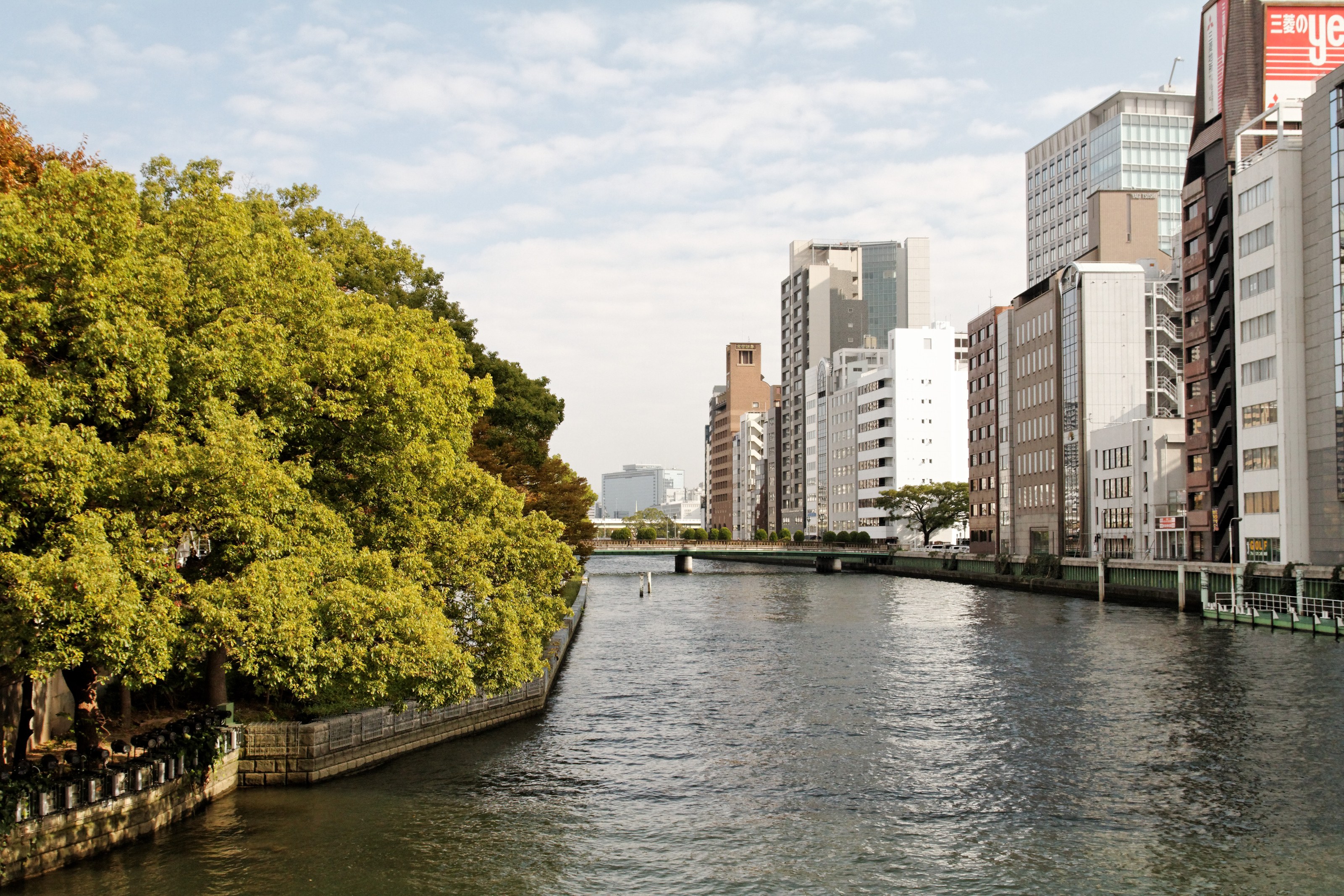
The older photograph placed here shows the Tosabori in November 2010, with trees facing a dense line of buildings. Its date is part of its caption because autumn does not look identical each year. Planting changes, weather changes and a camera makes its own choices. The picture can show how greenery mediates an urban edge without pretending to tell you the condition of every tree on your visit.
Give yourself permission to sit where seating is available and appropriate. Put the phone away for a few minutes. The difference between pausing and waiting is that nothing has to happen before a pause becomes worthwhile. You can study the route you have already walked, notice which side of a bridge is receiving light, or decide that you have seen enough for the afternoon. Rest is not a failure of curiosity.
Do not let an old timetable steer
A boat trip can offer another angle, but it is an additional booking, not a necessary component of this walk. Osaka's waterfront tourism information includes seasonal services and temporary events. Listings can apply to limited dates, and the portal's translated date fields are not always consistent. Confirm the date, departure pier, return arrangements, accessibility and weather policy with the operator before paying. A route drawn across water tells you where a boat might go, not that it operates when you need it.
For the same reason, avoid stitching separate waterfront attractions into a continuous promenade unless the current route is confirmed. Where a path ends, follow lawful signed streets and crossings. Do not climb around a barrier to preserve the elegance of a map. Keep the day's route flexible enough that an unexpected closure costs a few minutes of reconsideration rather than an argument with the place.
In wet or windy conditions, favour secure walking surfaces and remain back from exposed edges. Check local weather warnings and transport notices. An umbrella is not a reason to continue a river walk during severe weather, and the promise of an evening photograph is not a reason to ignore deteriorating conditions. Osaka offers more than one kind of afternoon; choose the one the day can support.
The return crossing
Before leaving, cross the river once more if the route and conditions allow. The opposite bank changes the apparent relationship of buildings you have already passed. What seemed dominant can recede; a gap that went unnoticed can become the centre of the view. This small revision is one of the pleasures of a place with two accessible sides.
Nakanoshima does not need to quiet the whole city to give it another register. The offices remain offices, the hall has its own programme and the transport network carries people elsewhere. For a while, however, the river lets the visitor look across rather than rush through. Leave with the names of the two waterways clear in your mind. They are not background to the city you came to see. They are part of how it holds together.
“The water gives you somewhere to place your eye before choosing what to look at next.”
A considered route
- ArriveFind the river
Orient at Yodoyabashi or Kitahama using current signs and accessible exits.
- LookCivic architecture
Consider the Central Public Hall from outside; interior access depends on current arrangements.
- UnwindPark and return crossing
Choose an open section of Nakanoshima Park and leave by a convenient station.