
A canal asks you to follow it. A garden pond asks you to stop. In Suzhou, those two instructions sit close enough together to make a useful day: movement through a neighbourhood, then attention within an enclosure. Water becomes a route in one setting and a way of organising a view in the other. The distinction is more revealing than the familiar comparison with Venice. Suzhou needs no borrowed identity to explain why a bridge, a lane and a garden wall belong in the same picture.
Start with a small ambition. Choose the Pingjiang area and one classical garden, leaving space between the two for a meal and an unhurried walk. This is not a method for collecting the largest possible number of heritage sites. It is a way to notice the change in scale when you step from a street into a designed landscape. Bring a map, but resist turning its symbols into obligations. A garden studied with some patience can occupy more of your memory than several gardens hurried through before a return train.
Two ways of following water
Suzhou's municipal account of Pingjiang describes a neighbourhood where canals and streets run alongside one another. That paired arrangement is the essential fact to carry into a walk. Follow the land route and watch how a crossing changes what is visible: the line of a wall, the next bend, the length of a reflection. Water is not a decorative strip added to a pedestrian experience. It helps explain the shape of the district through which the pedestrian moves.
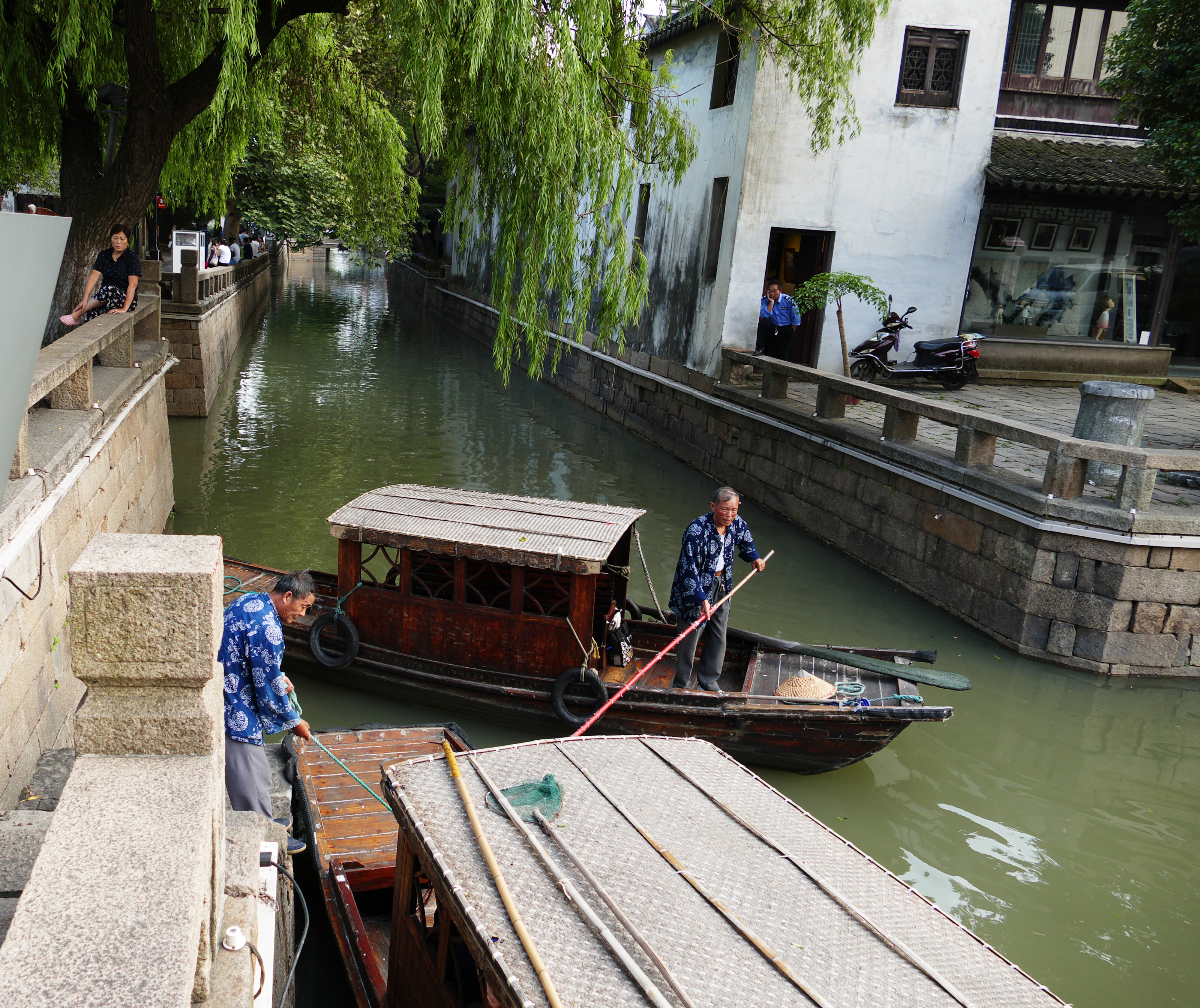
The archive photograph here catches covered boats close to the bank, with branches above and buildings immediately beside the channel. It was taken in September 2015, not on a scouting visit for this issue. Its value is spatial rather than predictive. It shows the proximity of water, work and domestic frontage; it cannot promise today's boarding point, fares or operating conditions. Treat a photograph as evidence of a particular view at a particular moment, then use the actual street to discover what has changed.
This proximity also calls for practical restraint. Leave doorways clear, stand aside before opening a map and ask before making a person the subject of a photograph. A bridge is a crossing before it is a camera position. If the narrowest point is busy, look from somewhere else instead of waiting in a way that prevents others passing. None of these choices requires a performance of virtue. They simply make a walk more comfortable for the people who did not travel there to take one.
A landscape measured in steps
The UNESCO inscription covers nine classical gardens, rather than every green space in the city. Its account describes landscapes made from water, stone, plants and buildings within the limits of residential sites. The Humble Administrator's Garden is one of those nine. The important idea is not that a garden reproduces a large natural landscape exactly, but that a small arrangement can invite the eye to imagine a larger one. A pond does not need the dimensions of a lake to create distance between one side and the other.
Try reading the garden in three passes. First follow the permitted route without attempting to photograph everything. Next choose a place where the water, a structure and a planting edge can be considered together. Finally return, if the route allows, to a view already seen. Your second encounter need not produce a revelation. Often it is enough to recognise how much of the first impression was created by your own hurry: the quick selection of a centre, the failure to look at an edge, the assumption that the next opening must contain something better.
Keep this exercise modest. You do not need to invent a symbolic meaning for every stone or claim an understanding of a poem you cannot read. Use the site's interpretation or a knowledgeable guide for names, literary references and historical changes. There is pleasure in separating what you can see from what you need to learn. The surface of the pond, the shape of a passage and the relationship between a roof and its reflection are available to the eye; their cultural histories deserve more than confident guesswork.
Winter is not a missing summer
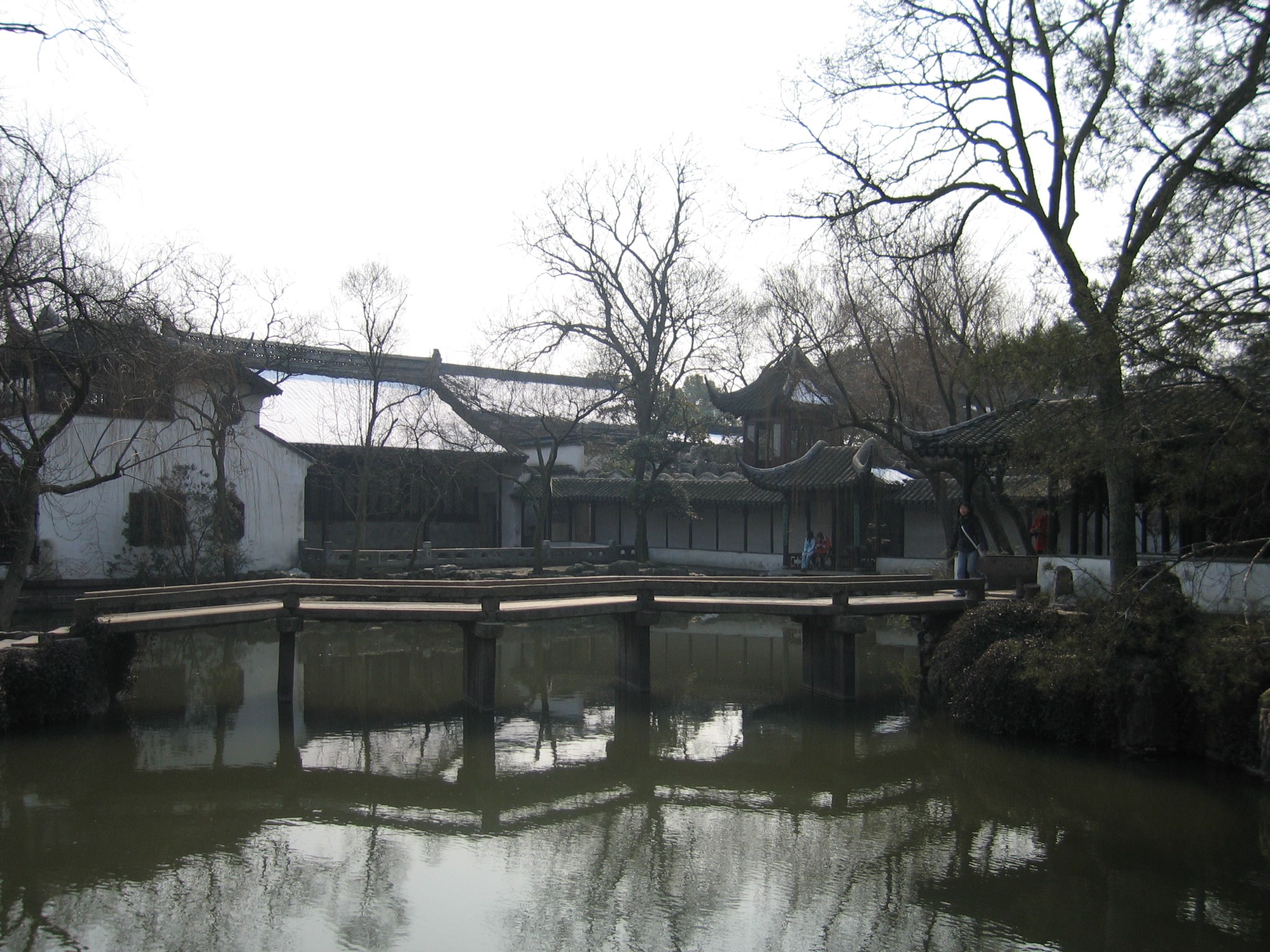
Our second photograph shows the Humble Administrator's Garden in winter: bare branches, pale walls and a low crossing reflected in the pond. It is an archive image, uploaded in 2010. It offers a useful counterweight to pictures dominated by flowers. The framework of a garden can become particularly legible when seasonal colour is less insistent. That is an invitation to look, not a promise about the weather or foliage on a November visit.
Do not build the day around a flowering date lifted from an old guide. Likewise, avoid transferring a summer opening time into a different season. A municipal notice introduced a 06:45 opening for the Humble Administrator's Garden from 19 June to 7 October 2026. That period has ended. The same notice describes named, timed reservations. Before travelling, confirm the current opening hours, the booking route and the identity document accepted for your reservation. International visitors should check passport handling directly rather than assuming instructions for domestic identity cards apply unchanged.
A successful reservation is part of the visit, not an administrative inconvenience outside it. Save the confirmation where it can be retrieved without dependable mobile data; check the exact garden name and date; leave enough time to reach the entrance without running. Do not ask staff to solve a scheduling problem by disregarding an entry rule. If the booking does not work, simplify the day. An independent walk and a later, properly arranged garden visit are better than buying an uncertain promise from someone at the gate.
Leave room outside the garden
Resist treating lunch as the interval in which you recover time lost to looking. Choose somewhere with a clear menu and prices, explain dietary requirements without assuming shared vocabulary, and allow enough time for the meal you order. This route does not depend on a named restaurant or a supposedly secret dish. Its purpose is to keep the day grounded in the district rather than turning every decision into another search across the city.
The same approach applies to shopping. If an object interests you, ask what it is, who made it and whether it was made locally. Do not infer provenance from a picturesque setting. A small, considered purchase can carry a specific memory; a bag of things bought to certify that you visited a famous street rarely does. Where a performance or demonstration is offered, establish the charge and whether photography is welcome before settling in.
Rain should change the route. Wet paving, thresholds and bridge approaches can require more care than a broad street. Choose secure footwear and keep both hands available where needed. Travellers with mobility requirements should ask the individual garden about steps, surfaces, accessible entrances and usable facilities before booking. Historic surroundings are not a reliable proxy for either accessibility or inaccessibility; the relevant information is the actual route available to you.
What the wall changes
At the end of the garden visit, return your attention to the street. The movement outside can make the enclosure you have just left feel unusually concentrated. Yet the wall has not separated culture from ordinary life. Both sides require maintenance, practical decisions and people whose work is easily excluded from the visitor's image. It is worth noticing the gate being managed and the path being cared for, without turning the workers themselves into another attraction.
Suzhou rewards this change of scale. Follow a canal far enough to understand that it continues beyond your chosen photograph. Then spend time beside a pond whose edges you can see, without assuming you have exhausted what it contains. The day's achievement is not a completed circuit. It is a more precise question: how much space does water need to alter the way a city is seen? Here, sometimes, no more than the distance between a path and a wall.
“A canal asks you to follow it. A garden pond asks you to stop.”
A considered route
- OrientPingjiang
Follow an established public canal-side street, leaving crossings and doorways clear.
- PauseOne classical garden
Arrange entry first; spend time considering water, walls and changing views.
- ReturnAn unhurried meal
Leave enough time to eat and return without adding another distant attraction.