
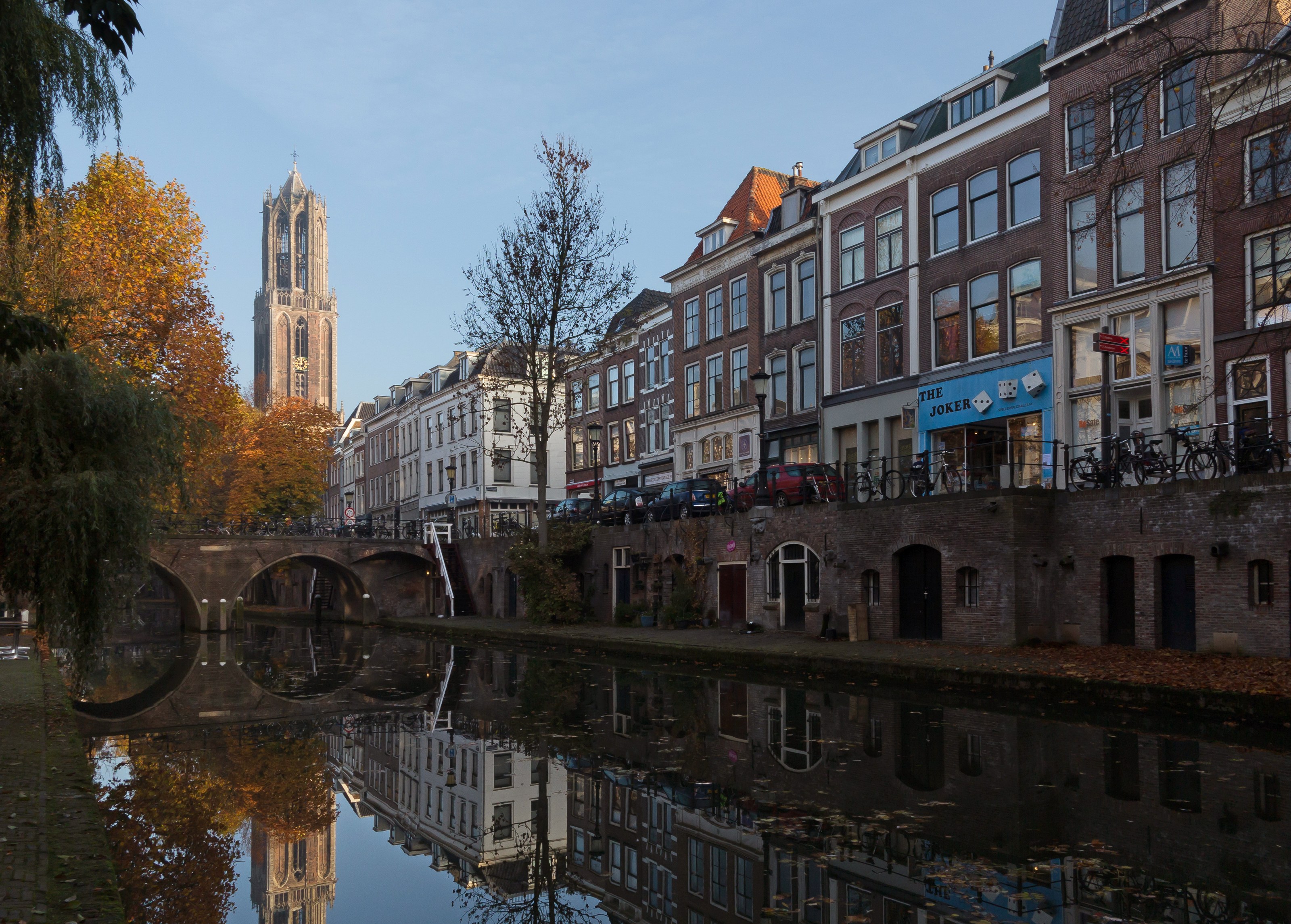
The first useful view of Utrecht is not necessarily from its tallest tower. Stand instead on a bridge over the Oudegracht and look sideways. A road runs beside the buildings, but below it is another strip of city: doors, brick walls, paving and the water itself. The apparent basement is a frontage. What seems, from above, to be a picturesque margin was once part of the city's machinery for receiving and storing goods.
That change of level gives Utrecht a particular intimacy. The canal is not merely something to cross on the way to a monument. It asks you to understand how a building meets a boat, how a street can have another street beneath it, and how yesterday's commercial advantage becomes today's responsibility. A good walk here is less a sequence of sights than an exercise in looking at the same place from two heights.
An elongated harbour
The Oudegracht connects water routes through the old city. Regional tourism material describes the raised banks created during its construction and the wharves that developed below street level. The arrangement made a practical relationship between navigation and storage: cargo could move from boat to waterside working space and into cellars beneath the buildings. The canal's historical purpose was not to provide a scenic gap between handsome houses.
Keep that purpose in mind when looking at the doors. They are not interchangeable decorative details. Their positions reveal the value of direct access to water. Imagine the route of an object rather than inventing a scene of medieval labour: where would it be unloaded, protected from rain, carried upstairs or transferred to a customer? The surviving layout supplies the questions even where a particular building's history needs further research.
Present-day uses make those questions more interesting. Some cellar spaces accommodate businesses; others belong to residents. A lit interior is not an invitation to enter, and a door at water level is not necessarily a visitor attraction. The shared achievement is the survival of an adaptable urban structure, not the conversion of every room into something to consume.
The difference between old and unchanged
Municipal heritage research makes clear that the wharves have not arrived untouched from the Middle Ages. As transport patterns changed, their commercial role diminished. Later public ownership and restoration helped turn former working spaces into the lower streets recognised today. What looks continuous from a bridge contains episodes of neglect, reconstruction and changing ideas about who should be able to use the edge.
This matters because a visitor can mistake visible age for the absence of decisions. Brickwork has to be inspected. A tree's roots and a retaining wall may compete for space. Water, paving, cellar roofs and the traffic above form one complicated section through the city. Preserving each part in isolation is not enough. The canal view depends on people resolving the points where those parts meet.
The city's current repair information is therefore worth reading alongside its heritage stories. Notices describe individual stretches and planned work rather than treating the canal as one permanently finished monument. A barrier may interrupt the photograph, but it also tells you that the place is being maintained. A detour is not evidence that Utrecht has failed to resemble its own publicity.
A route that can change levels
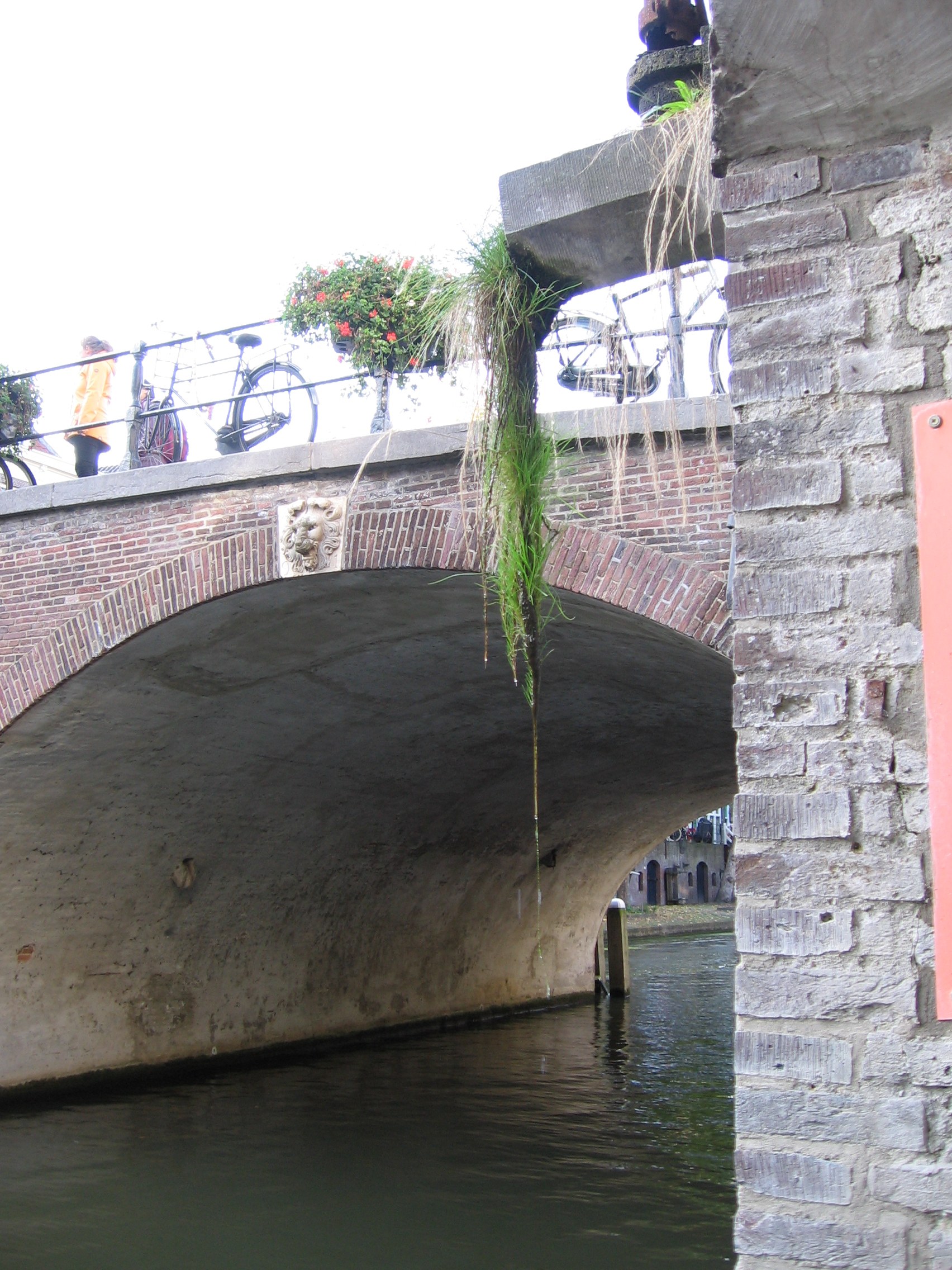
Begin with a modest stretch of the Oudegracht rather than a promise to follow every metre. From an upper pavement, compare the rhythm of windows with the doors below. At a bridge, pause out of the flow of other pedestrians. When a signed, open stairway gives access to a public wharf, the lower position changes the proportions: walls rise, bridge arches become ceilings, and the ordinary work of holding back earth becomes visible.
Do not assume that every descent has a convenient exit farther along. Check the next connection before committing to a lower section, especially with children or anyone for whom stairs are difficult. The upper route is a complete way to experience the canal, not a consolation prize. From there, the relationship between house, cellar and quay is often easier to read.
Wet paving deserves attention. Leave room at edges, keep clear of working doorways and resist the temptation to step backwards for a wider photograph. A canal walk should not require balancing a body where a camera would prefer it. Choose a stable viewpoint and let the limits of that position determine the picture.
Another kind of water: the singel
The Oudegracht runs through the city; the singel helps describe its boundary. Utrecht's municipal account connects the surrounding water to the city's medieval defences, later dismantling of the walls and twentieth-century changes for road traffic. Since 2020, water once again forms a complete circuit around the old centre. The restored Catharijnesingel belongs to this wider story, rather than being an extension of the wharf system.
Moving between the two offers a useful contrast. At the Oudegracht, attention narrows to the thickness of a wall or the underside of a street. Beside the singel, the question becomes one of urban priorities. What happens when a city gives space back to water? Which journeys become pleasant enough to make on foot, and which older habits of movement need to change?
The restoration should not be read as a simple return to an untouched past. It is a modern intervention, undertaken by a city with contemporary needs. That is precisely its interest. Heritage can inform a new arrangement without requiring every period of history to disappear beneath an idealised image of the oldest one.
Let the season edit the walk
An autumn visit benefits from a plan with an indoor pause, a short first leg and no obligation to remain by the water after comfort has gone. Wind, rain and shortening daylight affect how long a canal bench or exposed bridge remains an attractive place to linger. The archive photographs here show particular dates, not a promise of the same foliage, light or water conditions during your stay.
Choose a café or other indoor stop on its own merits after checking that it is open. No cellar restaurant is recommended simply because it occupies a photogenic room. If you want a particular waterside table, ask the business about access and reservations directly. Architecture may explain why a room is memorable; it does not establish the quality of its food or the suitability of its entrance.
A boat outing is a separate decision. Check the operator, boarding arrangements and current service before adding it to the walk. Seeing the canal from water level can be revealing, but a ticket is not essential to understanding the system. The bridges and public upper streets already offer a sequence of carefully different views.
Looking after the view
Utrecht rewards an unusually small scale of attention. A gutter, a repaired joint or the point where a stair meets the quay can explain more than another wide shot of the tower. These are not minor things surrounding the main attraction. They are the connections that allow an inhabited city to keep using its water edge.
The most useful souvenir may be a changed understanding of a familiar word. A waterfront need not be a broad promenade beside a large river. Here it can be a narrow working threshold, doubled in height and altered repeatedly over centuries. Look down, then look back up. The city becomes larger when you notice how much of it occupies the space between.
“The apparent basement is a frontage.”
A considered route
- BeginLook across the section
Compare houses, upper pavement, cellar doors and water from a public bridge, keeping the pedestrian route clear.
- ContinueChoose one open lower stretch
Check both access and exit before descending; never enter a private cellar or restricted work area.
- CompareFind the singel
Use the surrounding water to contrast modern restoration with the canal's commercial history.