
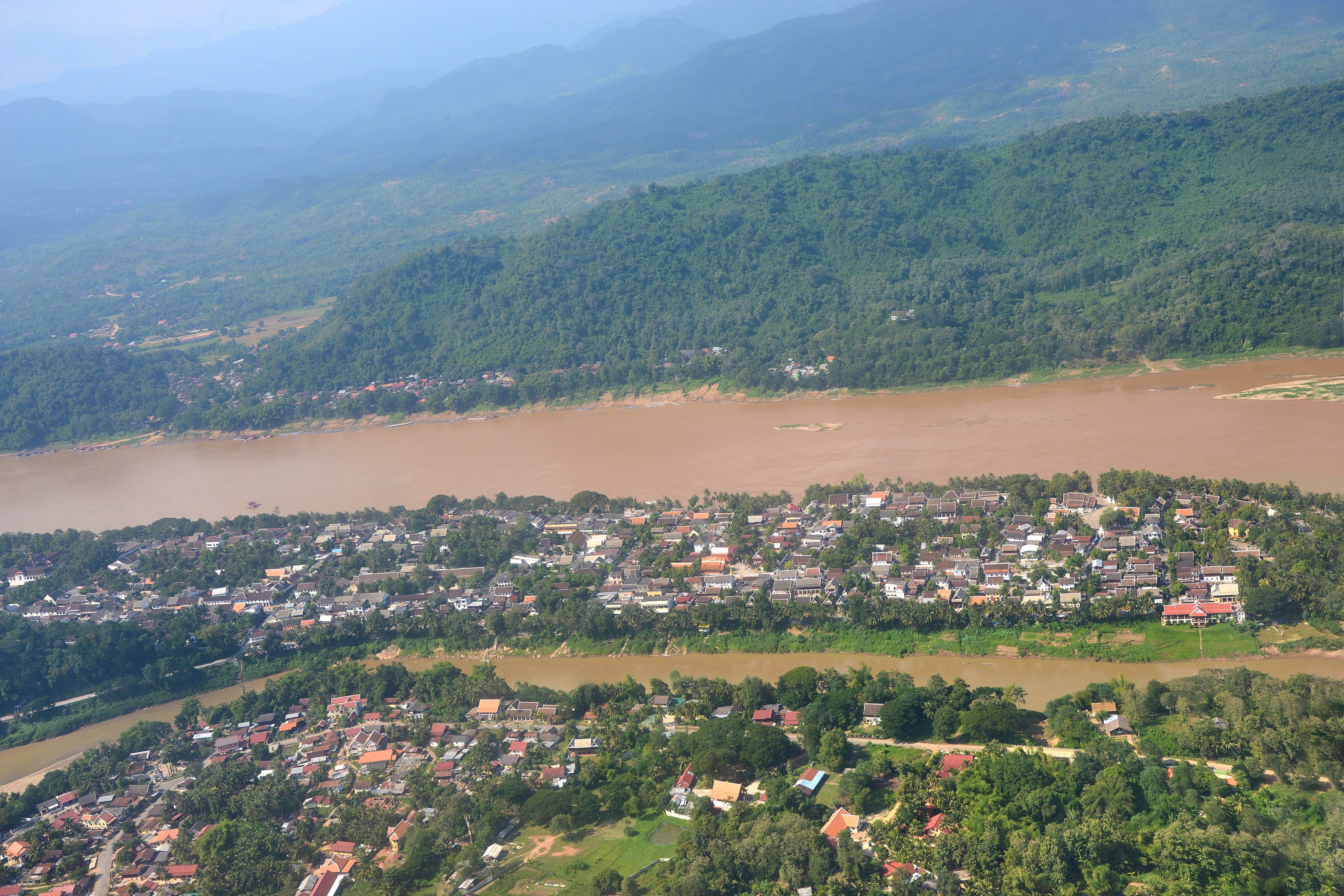
The aerial photograph opening this story makes a shape legible that is harder to hold in mind at street level. Buildings occupy a tongue of land between the Mekong and the Nam Khan, with wooded slopes beyond. It was photographed from an aircraft in November 2014. It is not a current survey, but it gives a clear starting point for a visit: Luang Prabang is not simply a sequence of temples and riverside viewpoints. Its historic peninsula has two different water edges, and walking between them changes the scale of what you see.
The temptation is to turn that shape into a neat circuit. Resist doing so too quickly. A map can join roads while saying little about heat, steps, traffic, current access or the time a place deserves. Choose a modest section of the peninsula, ask locally about a comfortable route and leave gaps in the day. The aim is not to trace a line around the town. It is to understand why the rivers matter without asking them to supply an uninterrupted performance of beauty.
Geography before the photograph
UNESCO describes the historic town as a combination of Lao urban and architectural traditions with buildings from the colonial period, set within a mountainous landscape. Its account also recognises the importance of living religious practice and the pressure tourism can place on the town. These are not separate subjects to be allocated to separate days. The buildings, their present uses and the visitor economy occupy the same streets.
From a permitted public viewpoint near the meeting of the rivers, begin with what you can actually establish. Which bank are you standing on? Where does the smaller watercourse enter the larger one? Which route brought you here, and which will take you back without relying on an unverified crossing? A few minutes spent orienting yourself can be more useful than a photograph whose caption merely says that the view was beautiful.
The water's appearance should not be mistaken for a safety report. Colour, apparent smoothness and the absence of visible obstacles do not establish that a river is safe to enter or cross. Keep to established public paths and do not descend an informal bank for a better angle. A place can be worth looking at without being something to approach as closely as possible.
A temple is a present-tense place
Wat Xieng Thong stands near the river confluence. The provincial tourism office places its foundation around 1560 and describes its sweeping roof and glass mosaics. Those features provide a more specific reason to visit than a ranking of the town's most photogenic buildings. Allow time to consider one structure and its details, rather than treating the complex as the backdrop for a portrait.
Follow the directions given at the site about dress, footwear, photography and access. Ask before entering an area whose purpose is unclear. Pay any current admission charge through the proper channel, and recognise that a ticket does not buy unrestricted access to religious life. Where an activity is taking place, the appropriate response may be to stand well back or leave a space undisturbed.
It is reasonable to arrive without knowing the meaning of every image. A knowledgeable local guide can help distinguish decorative elements, religious narratives and later restoration. Budget for that expertise if it matters to your visit. Do not replace explanation with a story invented from the surface of a photograph, and do not press someone engaged in other duties to become an unpaid guide simply because they are present.
Dawn does not belong to the camera
Morning alms giving, Sai Bat, is a living Buddhist practice rather than a performance staged for the visitor. The local tourism office asks observers to remain silent, keep their distance and avoid obstructing participants. It advises appropriate covering of shoulders, chest and legs, no flash, no physical contact with monks, and at least five metres of distance for people observing. Participation should be meaningful and properly understood, not purchased merely to create an image.
Consider whether you need to attend at all. A visit to Luang Prabang is not incomplete without a dawn photograph. If the available space is crowded, withdrawing can be a better decision than searching for a more intrusive position. Do not follow people into a quieter residential area because a guidebook has described it as more authentic. The absence of other visitors is not consent.
The most useful preparation happens before morning. Ask a responsible local source what conduct is appropriate, decide whether you will observe or participate, and accept that the answer may be to do neither. Keep cameras subordinate to the practice rather than arranging your behaviour around a desired frame. These choices do not make the visitor an expert in another person's faith. They establish the minimum conditions for being a considerate guest.
A confluence is not a crossing
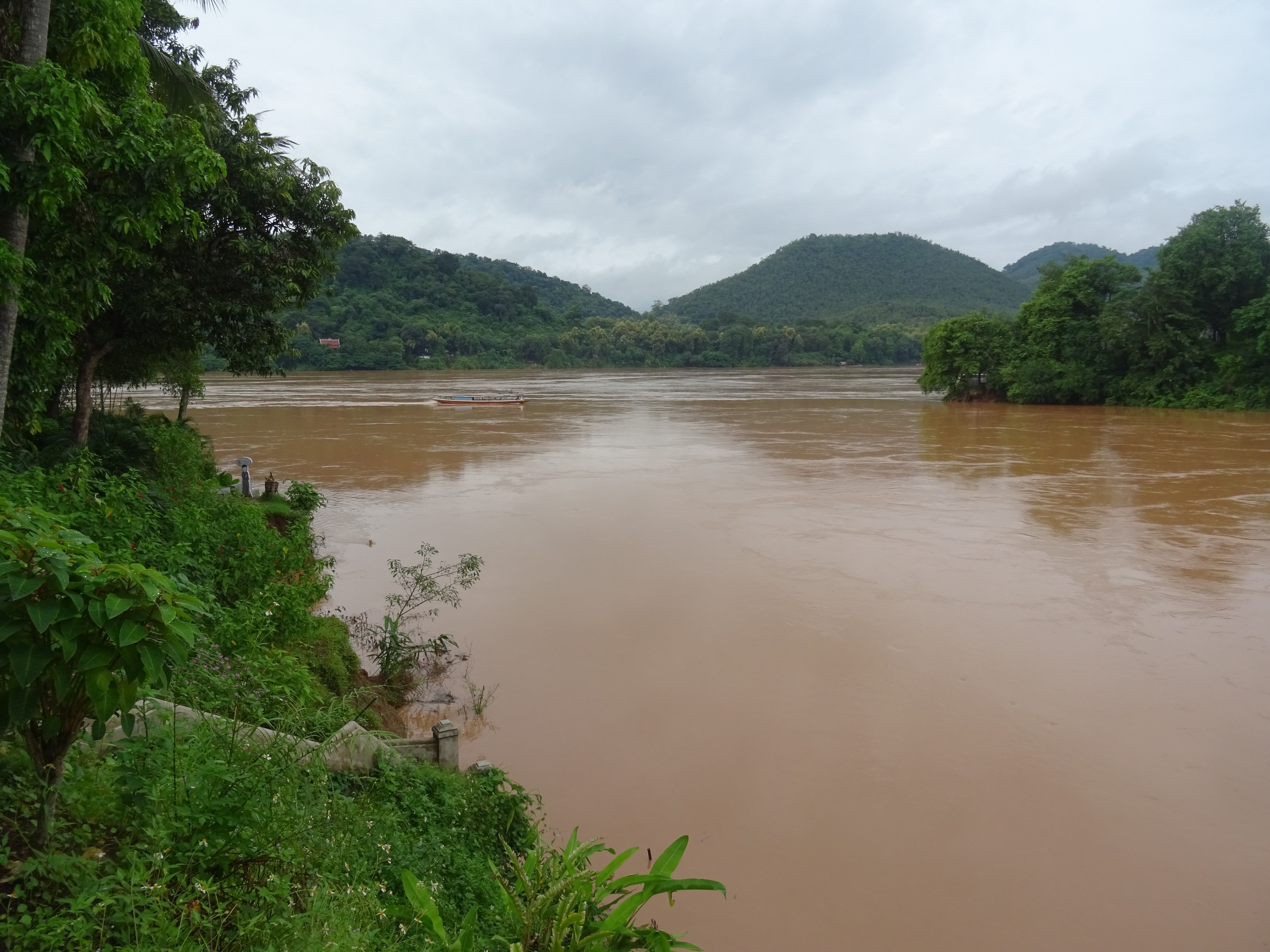
The second photograph records the Nam Khan meeting the Mekong in August 2018. Dense green banks and brown water fill the scene. Like the aerial image, it is dated deliberately: water levels and bank conditions change, and an old photograph should never certify a route. Do not build this walk around a temporary bamboo bridge shown in someone else's travel account. Establish the current lawful crossing locally, or remain on the peninsula.
Boat travel deserves a separate safety decision. UK travel advice warns that changing water levels, strong currents and hidden obstacles can make Mekong journeys dangerous. If considering a boat, check the operator, the vessel, suitable lifejackets for everyone and the return arrangements. Do not accept a departure merely because a salesperson says it is routine. A river view can be enjoyed from land if you cannot establish conditions you are comfortable with.
The same caution applies to ambitious extensions. A short town walk does not require a remote bank excursion, a speedboat journey or a last-minute change of accommodation. Keep enough money and time in reserve to decline an uncertain arrangement. Check current official travel advice before departure, including regional warnings, entry requirements and insurance. Advice for a country is not necessarily uniform across every province, and a familiar destination name does not remove the need to read it.
Let the town keep its ordinary hours
Make lunch and rest part of the plan rather than evidence that the plan has failed. In warm conditions, a smaller route with an adequate break is more useful than a full circuit completed while exhausted. Choose an established business with clear prices, discuss dietary requirements carefully, and avoid turning an ordinary purchase into a negotiation over the smallest possible amount. A visitor's inexpensive afternoon is someone else's workday.
Ask accommodation providers specific questions about access and location. A river view says nothing about the number of steps to a room, the gradient of the approach or whether a vehicle can reach the entrance. Travellers with mobility requirements should confirm surfaces, stairs and bathroom arrangements directly. Photographs of a charming façade are not a substitute for an accurate description of the facilities you need.
In the streets, keep the boundary between public and private visible. A door standing open does not invite photography inside. Children are not subjects to be gathered into an album without consent. Where you want to learn more about a neighbourhood, pay for appropriate local knowledge rather than assuming that access to a street confers access to its residents' lives.
Two banks, one responsibility
A useful final exercise is to put away the aerial image and draw a rough shape from memory. Mark the two rivers, the places where you paused and the route you actually used. Leave gaps where you are unsure. The result need not be geographically elegant. Its value lies in distinguishing a place encountered from a place merely consumed as a set of pictures.
Then return to the photograph and notice what it cannot tell you: how a threshold is managed, what worship requires, which bank is accessible today, or what a boat operator's safety arrangements are. Those questions belong to the living town. They are not interruptions to its beauty. They are part of the attention that beauty should invite.
Between the Mekong and the Nam Khan, the visitor has a choice about the kind of presence to make. It can be hurried and acquisitive, moving from one expected scene to the next. Or it can be limited, curious and willing to change course. The rivers make a memorable outline. A considerate visit leaves room inside that outline for the people whose lives continue after the camera is put away.
“The rivers make a memorable outline. A considerate visit leaves room inside that outline for the people whose lives continue.”
A considered route
- OrientThe peninsula
Identify the two waterways and a comfortable public route back.
- VisitWat Xieng Thong
Confirm access, observe dress and photography rules, and allow worship priority.
- PauseA public river viewpoint
Stay on established paths; do not descend informal banks or assume an old crossing remains.